http://www.weerwoord.be/includes/forum_read.php?id=1634513&tid=1634462
Gisteren schreef Frank:
'Doordat de temperatuurtegenstellingen tussen noordpoolgebied en evenaar afnemen (lage nao) neemt de westcirculatie af. Hierdoor krijgen we meer te maken met hardnekkig geblokkeerde luchtdrukpatronen. Helemaal verklaren kan ik het niet, maar de blokkades liggen de laatse jaren zo dat wij een wisselvallige relatief koele zomer krijgen en oost-europa veel droogte en hitte. Het azorenhoog vormt ook weinig uitlopers in onze richting.'
Dit staat volgens mij (?) haaks op (ik neem aan dat Frank bedoelt kleinere temperatuurverschil leidt tot lagere of negatieve NAO):
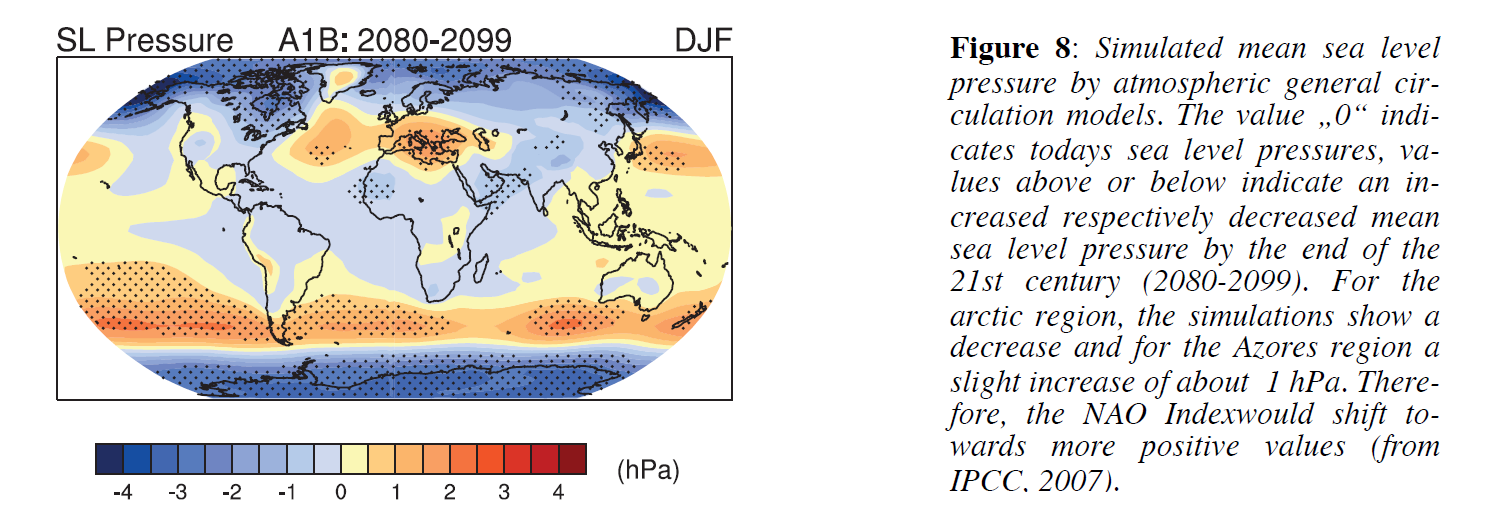
In the 4th assessment report of the International Panel on Climate Change (IPCC, 2007) the authors
state that many simulations project a decrease in arctic sea level pressure in the 21st century (see
figure 8). This would lead to an increase of the NAO Index, which was confirmed by half of the simulation models investigated by Osborn (2004) and Kuzmina et al. (2005). Although the magnitude of the modelled pressure trends varies largely (IPCC, 2007), none of the models calculated an increasing pressure trend, which makes lower arctic sea level pressure and therefore a higher index very probable (Miller et al., 2006; IPCC, 2007). Furthermore, climate models simulations for NAO with regard to troposhperic processes project an increased index in response to increasing CO2 concentrations, although this response is not that large and it‘s magnitude depends on the model
Wellicht is er sprake van een tijdelijk meer negatieve NAO dan positieve NAO? http://www.up.ethz.ch/education/term_paper/termpaper_hs07/BACHMANN_rev_termpaper_hs07.pdf
Gisteren schreef Frank:
'Doordat de temperatuurtegenstellingen tussen noordpoolgebied en evenaar afnemen (lage nao) neemt de westcirculatie af. Hierdoor krijgen we meer te maken met hardnekkig geblokkeerde luchtdrukpatronen. Helemaal verklaren kan ik het niet, maar de blokkades liggen de laatse jaren zo dat wij een wisselvallige relatief koele zomer krijgen en oost-europa veel droogte en hitte. Het azorenhoog vormt ook weinig uitlopers in onze richting.'
Dit staat volgens mij (?) haaks op (ik neem aan dat Frank bedoelt kleinere temperatuurverschil leidt tot lagere of negatieve NAO):
In the 4th assessment report of the International Panel on Climate Change (IPCC, 2007) the authors
state that many simulations project a decrease in arctic sea level pressure in the 21st century (see
figure 8). This would lead to an increase of the NAO Index, which was confirmed by half of the simulation models investigated by Osborn (2004) and Kuzmina et al. (2005). Although the magnitude of the modelled pressure trends varies largely (IPCC, 2007), none of the models calculated an increasing pressure trend, which makes lower arctic sea level pressure and therefore a higher index very probable (Miller et al., 2006; IPCC, 2007). Furthermore, climate models simulations for NAO with regard to troposhperic processes project an increased index in response to increasing CO2 concentrations, although this response is not that large and it‘s magnitude depends on the model
Wellicht is er sprake van een tijdelijk meer negatieve NAO dan positieve NAO? http://www.up.ethz.ch/education/term_paper/termpaper_hs07/BACHMANN_rev_termpaper_hs07.pdf
Bericht laatst bijgewerkt: 25-06-2012 18:37
„Et nul ne se connait tant qu'il n'a pas souffert, „C'est une dure loi, mais une loi suprème, „Vieille comme le monde et la fatalité, „Qu'l nous faut du malheur regevoir le baptéme, ~Et qu'a ce triste prix tout doit étre acheté. „Les moissons pour murir out besoin de rosée, „Pour vivre et pour sentir l'homme a besoin de pleura, „La joie a pour symbole une plante brisée, „Humide encore de pluie et couverte de fleurs."