Door het welbekende Duitse Max-Planck instituut wordt het project STRATO uitgevoerd. Dit om de klimaatvoorspellingen voor de middellange termijn (tm 30-40 jaar?) te verbeteren. Dit sluit m.i. goed aan bij kritiek op de klimaatmodellen van o.a. Scaife (UKMO). http://nldr.library.ucar.edu/repository/assets/osgc/OSGC-000-000-002-080.pdf
http://www.fona-miklip.de/en/302.php
The project STRATO aims to study and evaluate the importance of the stratosphere for mid-term predictions of climate change. The focus is laid on the quantification of reactions of the coupled atmosphere-ocean system to decadal stratospheric variability. Recent analyses of observations and data from numerical model simulations show a clear impact of decadal stratospheric fluctuations on the troposphere. Therefore one can proceed from the assumption that a consideration of stratospheric processes will lead to improved decadal climate predictions. STRATO concentrates on investigations of the role of the decadal solar activity (i.e. the 11-year solar cycle, cf. Figure 1) and internal stratospheric variability on decadal time-scales and the subsequent tropospheric reactions (cf. Figures 2 and 3).
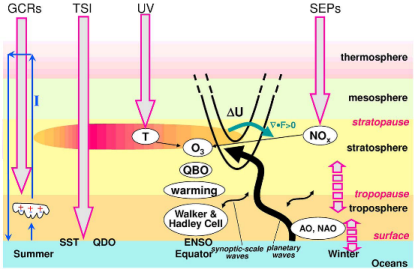
Figure 1: Schematic diagram of solar influence on climate based on Kodera and Kuroda (2002). Shown are the direct and indirect effects through solar irradiance changes (TSI and UV) with respect to Smax as well as corpuscular radiation effects (energetic particles and GCRs). The two dashed ar-rows denote the coupling between the stratosphere and the troposphere and the coupling between the ocean and the atmosphere. (Figure from Gray et al., 2010)
It is expected that results of the STRATO project will establish enhanced knowledge of the in-teractions between the stratosphere and the troposphere-ocean system, improving mid-term climate prediction. In particular, STRATO will improve the basic understanding of the impacts of decadal solar variability and internal stratospheric fluctuations on the atmosphere-ocean system on decadal time-scales. Based on investigations carried out in STRATO, recommendations to further develop the MiKlip-forecast system will be transfered to the respective team; appropriate software will be provided to improve the quality of climate prediction on decadal time-scales. STRATO aims to contribute to a better understanding of the Earth’s climate system, leading to a generally improved climate modelling.
Goals
•Quantification of the influence of stratospheric solar forcing on decadal climate prediction.
•Determination of the importance of stratospheric internal variability for decadal climate prediction.
•Analysis and evaluation of the relevance of stratospheric decadal variability for the coupled atmosphere-ocean system.
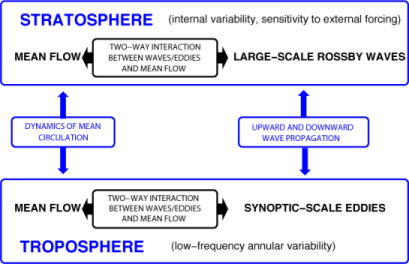
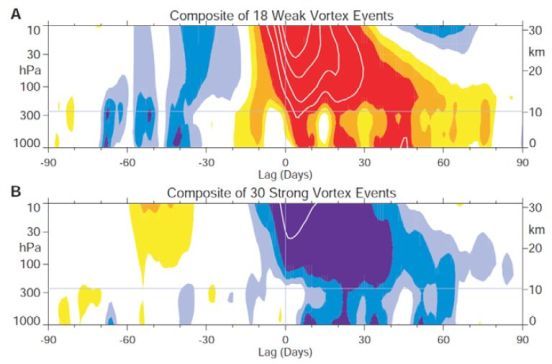
Figure 3: Composites of time-height development of the northern annular mode for (A) 18 weak vor-tex events and (B) 30 strong vortex events. The events are determined by the dates on which the 10-hPa annular mode values cross -3.0 and 11.5, respectively. The indices are non dimensional; the con-tour interval for the color shading is 0.25, and 0.5 for the white contours. Values between 20.25 and 0.25 are unshaded. The thin horizontal lines indicate the approximate boundary between the tropo-sphere and the stratosphere. (Figure from Baldwin und Dunkerton, 2001)
http://www.fona-miklip.de/en/302.php
The project STRATO aims to study and evaluate the importance of the stratosphere for mid-term predictions of climate change. The focus is laid on the quantification of reactions of the coupled atmosphere-ocean system to decadal stratospheric variability. Recent analyses of observations and data from numerical model simulations show a clear impact of decadal stratospheric fluctuations on the troposphere. Therefore one can proceed from the assumption that a consideration of stratospheric processes will lead to improved decadal climate predictions. STRATO concentrates on investigations of the role of the decadal solar activity (i.e. the 11-year solar cycle, cf. Figure 1) and internal stratospheric variability on decadal time-scales and the subsequent tropospheric reactions (cf. Figures 2 and 3).
Figure 1: Schematic diagram of solar influence on climate based on Kodera and Kuroda (2002). Shown are the direct and indirect effects through solar irradiance changes (TSI and UV) with respect to Smax as well as corpuscular radiation effects (energetic particles and GCRs). The two dashed ar-rows denote the coupling between the stratosphere and the troposphere and the coupling between the ocean and the atmosphere. (Figure from Gray et al., 2010)
It is expected that results of the STRATO project will establish enhanced knowledge of the in-teractions between the stratosphere and the troposphere-ocean system, improving mid-term climate prediction. In particular, STRATO will improve the basic understanding of the impacts of decadal solar variability and internal stratospheric fluctuations on the atmosphere-ocean system on decadal time-scales. Based on investigations carried out in STRATO, recommendations to further develop the MiKlip-forecast system will be transfered to the respective team; appropriate software will be provided to improve the quality of climate prediction on decadal time-scales. STRATO aims to contribute to a better understanding of the Earth’s climate system, leading to a generally improved climate modelling.
Goals
•Quantification of the influence of stratospheric solar forcing on decadal climate prediction.
•Determination of the importance of stratospheric internal variability for decadal climate prediction.
•Analysis and evaluation of the relevance of stratospheric decadal variability for the coupled atmosphere-ocean system.
Figure 3: Composites of time-height development of the northern annular mode for (A) 18 weak vor-tex events and (B) 30 strong vortex events. The events are determined by the dates on which the 10-hPa annular mode values cross -3.0 and 11.5, respectively. The indices are non dimensional; the con-tour interval for the color shading is 0.25, and 0.5 for the white contours. Values between 20.25 and 0.25 are unshaded. The thin horizontal lines indicate the approximate boundary between the tropo-sphere and the stratosphere. (Figure from Baldwin und Dunkerton, 2001)
„Et nul ne se connait tant qu'il n'a pas souffert, „C'est une dure loi, mais une loi suprème, „Vieille comme le monde et la fatalité, „Qu'l nous faut du malheur regevoir le baptéme, ~Et qu'a ce triste prix tout doit étre acheté. „Les moissons pour murir out besoin de rosée, „Pour vivre et pour sentir l'homme a besoin de pleura, „La joie a pour symbole une plante brisée, „Humide encore de pluie et couverte de fleurs."