Zie ook duiding van Ed, waarin hij refereert naar onderzoek Cohen.
Cohen schrijft er met Jones ook over in 2011 http://web.mit.edu/jlcohen/www/papers/CohenandJones_JC12.pdf
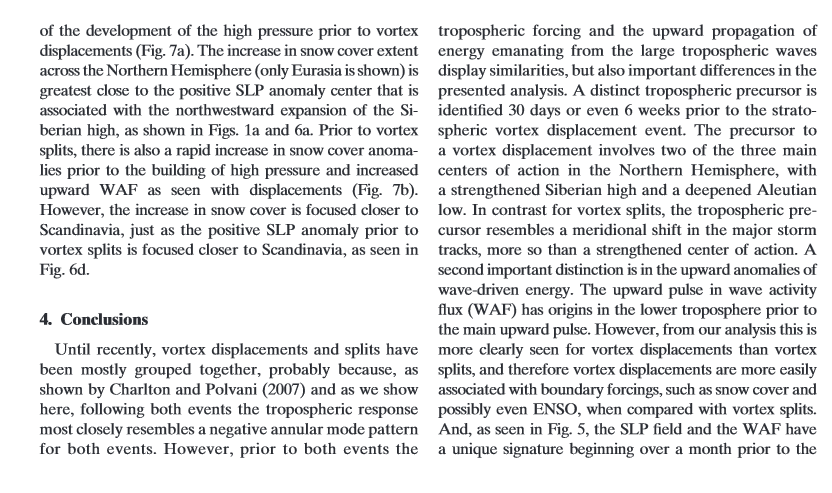
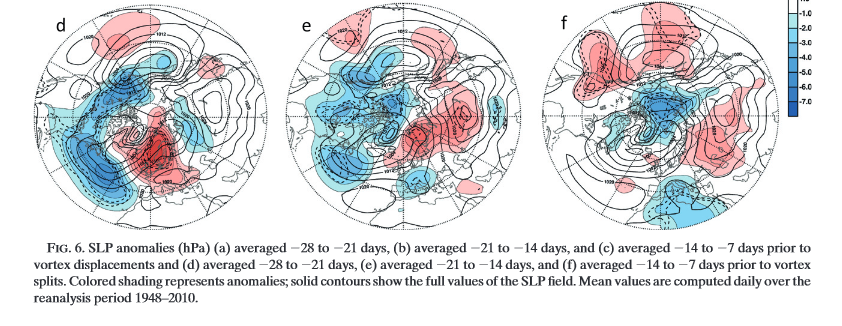
Zie dit plaatje, waarin je de ontwikkeling ziet naar negatieve AO. Let ook, op het meest linkse plaatje, dit lijkt op de huidige situatie! Ik heb het dan over het hoog en lagedruk bij Alaska, dat zijn nl. de belangrijkst twee onderdelen, zie plaatje met tekst, dat is een deel uit de conclusie van bovengenoemde artikel.
https://forum.netweather.tv/topic/81567-stratosphere-temperature-watch-20142015/
Any SSW will be triggered by the preceding tropospheric pattern - in fact the preceding troposheric pattern is important in disturbing the stratospheric vortex even without creating a SSW. Consider a tropospheric pattern where the flow is very zonal - rather like the positive AO phase in the diagram above. There has to be a mechanism to achieve a more negative AO or meridional pattern from this scenario and there is but it is not straightforward. It just doesn't occur without some type of driving mechanism. Yes, we need to look at the stratosphere - but if the stratosphere is already cold and a strong polar vortex established, then we need to look back into the troposphere. In some years the stratosphere will be more receptive to tropospheric interactions than others (such as the eQBO this year) but we will still need a kickstart from the troposphere to feedback into the stratosphere. This kickstart will often come from the tropics in the form of pulses of convection interacting with long wave undulations in the polar vortex which influence the positions of the sub tropical jet stream and polar jet streams respectively. The exact positioning of the large scale undulations (or Rossby waves) will be influenced by (amongst other things) the pulses of tropical convection (aka the phase of the MJO) and that is why we monitor that so closely. These waves will interact with land masses and mountain ranges which can absorb or deflect the Rossby waves disrupting the wave pattern further - and this interaction and feedback between the tropical and polar systems is the basis of how the Global Wind Oscillation influences the global patterns. The ENSO state will influence the GWO base state
Quote selectie
Cohen schrijft er met Jones ook over in 2011 http://web.mit.edu/jlcohen/www/papers/CohenandJones_JC12.pdf
Zie dit plaatje, waarin je de ontwikkeling ziet naar negatieve AO. Let ook, op het meest linkse plaatje, dit lijkt op de huidige situatie! Ik heb het dan over het hoog en lagedruk bij Alaska, dat zijn nl. de belangrijkst twee onderdelen, zie plaatje met tekst, dat is een deel uit de conclusie van bovengenoemde artikel.
https://forum.netweather.tv/topic/81567-stratosphere-temperature-watch-20142015/
Any SSW will be triggered by the preceding tropospheric pattern - in fact the preceding troposheric pattern is important in disturbing the stratospheric vortex even without creating a SSW. Consider a tropospheric pattern where the flow is very zonal - rather like the positive AO phase in the diagram above. There has to be a mechanism to achieve a more negative AO or meridional pattern from this scenario and there is but it is not straightforward. It just doesn't occur without some type of driving mechanism. Yes, we need to look at the stratosphere - but if the stratosphere is already cold and a strong polar vortex established, then we need to look back into the troposphere. In some years the stratosphere will be more receptive to tropospheric interactions than others (such as the eQBO this year) but we will still need a kickstart from the troposphere to feedback into the stratosphere. This kickstart will often come from the tropics in the form of pulses of convection interacting with long wave undulations in the polar vortex which influence the positions of the sub tropical jet stream and polar jet streams respectively. The exact positioning of the large scale undulations (or Rossby waves) will be influenced by (amongst other things) the pulses of tropical convection (aka the phase of the MJO) and that is why we monitor that so closely. These waves will interact with land masses and mountain ranges which can absorb or deflect the Rossby waves disrupting the wave pattern further - and this interaction and feedback between the tropical and polar systems is the basis of how the Global Wind Oscillation influences the global patterns. The ENSO state will influence the GWO base state
Quote selectie
Bericht laatst bijgewerkt: 12-11-2014 13:43
„Et nul ne se connait tant qu'il n'a pas souffert, „C'est une dure loi, mais une loi suprème, „Vieille comme le monde et la fatalité, „Qu'l nous faut du malheur regevoir le baptéme, ~Et qu'a ce triste prix tout doit étre acheté. „Les moissons pour murir out besoin de rosée, „Pour vivre et pour sentir l'homme a besoin de pleura, „La joie a pour symbole une plante brisée, „Humide encore de pluie et couverte de fleurs."

