De kans lijkt toe te nemen dat we deze winter met een Centrale Pacific El Nino te maken krijgen. Dat wil zeggen wil het een echte CP El Nino zijn dan hoort het eigenlijk een paar maanden te duren. Maar de condities zijn dus wellicht hetzelfde. http://www.cpc.ncep.noaa.gov/products/analysis_monitoring/lanina/enso_evolution-status-fcsts-web.pdf (met dank aan Karel, op het VWK-forum! http://www.vwkweb.nl/index.php?page=Forum&articleid=141&reference=ref214432&threadpage=3)
Waarom is dat van belang? Goede vraag &
& 
In een artikel uit 2012 Central Pacific El Niño, the “subtropical bridge,” and Eurasian climate
te vinden hier
http://onlinelibrary.wiley.com/enhanced/doi/10.1029/2011JD016493/
wordt gesuggereerd dat er twee type El Nino's zijn. Met duidelijk te onderscheiden gevolgen voor het NH.
In de conclusie staat het volgende. Samengevat komt het er op neer dat een CP EL Nino duidelijk leidt tot een negatieve NAO. Wederom is dit een signaal voor een winter met een negatieve NAO. Zie ook verdiepingsforum, presentatie MetOffice, die openlijk twijfelen aan hun modeloutput, of anders gezegd en misschien wel beter, zich afvragen hoe het toch komt dat er verschillende drivers wijzen op een negatieve NAO en hun model op een positieve NAO!?
De tekst uit hun conclusie
While for EP (eastern pacific, oostelijke pacific dus) El Niños there is a slight warming tendency over Europe, a field significance test for the Northern Hemisphere midlatitudes shows a high probability that these anomalies may occur by chance. A similar field significance test proves that midlatitude anomalies in near surface temperature and especially near surface pressure during CP El Niños are likely not due to chance. Europe becomes statistically significantly cooler in CP El Niño winters and a clear negative NAO phase is apparent from the pattern of statistically significant near surface pressure anomalies. During the CP El Niños 1914–1915, 1930–1931, and 1940–1941–1942, which are not included in our analysis, winters were as well characterized by negative values of the December to March NAO index
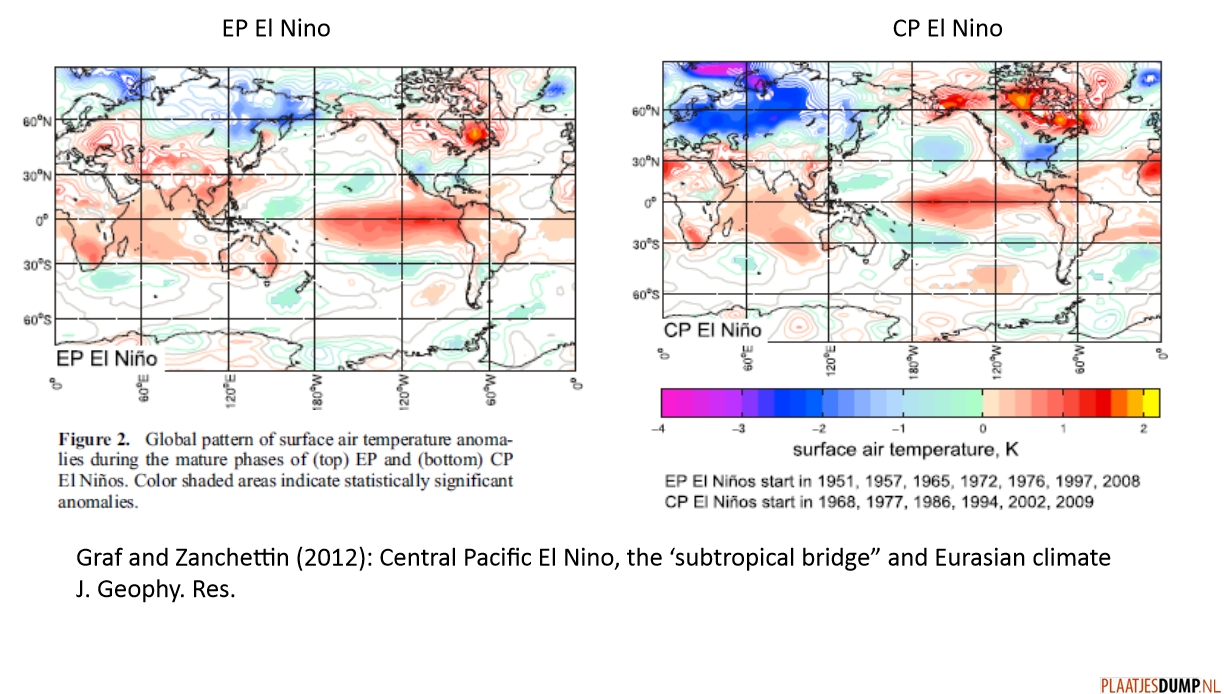
Waarom is dat van belang? Goede vraag
& In een artikel uit 2012 Central Pacific El Niño, the “subtropical bridge,” and Eurasian climate
te vinden hier
http://onlinelibrary.wiley.com/enhanced/doi/10.1029/2011JD016493/
wordt gesuggereerd dat er twee type El Nino's zijn. Met duidelijk te onderscheiden gevolgen voor het NH.
In de conclusie staat het volgende. Samengevat komt het er op neer dat een CP EL Nino duidelijk leidt tot een negatieve NAO. Wederom is dit een signaal voor een winter met een negatieve NAO. Zie ook verdiepingsforum, presentatie MetOffice, die openlijk twijfelen aan hun modeloutput, of anders gezegd en misschien wel beter, zich afvragen hoe het toch komt dat er verschillende drivers wijzen op een negatieve NAO en hun model op een positieve NAO!?
De tekst uit hun conclusie
While for EP (eastern pacific, oostelijke pacific dus) El Niños there is a slight warming tendency over Europe, a field significance test for the Northern Hemisphere midlatitudes shows a high probability that these anomalies may occur by chance. A similar field significance test proves that midlatitude anomalies in near surface temperature and especially near surface pressure during CP El Niños are likely not due to chance. Europe becomes statistically significantly cooler in CP El Niño winters and a clear negative NAO phase is apparent from the pattern of statistically significant near surface pressure anomalies. During the CP El Niños 1914–1915, 1930–1931, and 1940–1941–1942, which are not included in our analysis, winters were as well characterized by negative values of the December to March NAO index
„Et nul ne se connait tant qu'il n'a pas souffert, „C'est une dure loi, mais une loi suprème, „Vieille comme le monde et la fatalité, „Qu'l nous faut du malheur regevoir le baptéme, ~Et qu'a ce triste prix tout doit étre acheté. „Les moissons pour murir out besoin de rosée, „Pour vivre et pour sentir l'homme a besoin de pleura, „La joie a pour symbole une plante brisée, „Humide encore de pluie et couverte de fleurs."