Oktober staat op de kalender. En dat betekent dat we weer over de grens gaan kijken. Hieronder zag ik al heerlijke berichten uit Finland (bedankt Jan, staat de accuboor al klaar?) en EC toverde de nodige kou in delen van Scandinavië en NW van Rusland (Seppie bericht!). Ondertussen beleven wij al dagen achtereen superieur weer. Zalig om in de ochtend de winter al een beetje te voelen en 's middags de kracht van de zon.
Hier is van echt winterweer natuurlijk geen sprake. Te vroeg in het jaar. Maar elders op het NH wordt het langzamerhand toch witter en witter. Het is met andere woorden weer tijd om te kijken hoe het Siberische sneeuwdek er voor staat. Een leuke traditie hier op weerwoord!
Zeg je Siberisch sneeuwdek, dan denk je aan Judah Cohen. Een welbekende wetenschapper uit de VS.
Vorig jaar hebben Paul en ik een interview gehouden met Judah Cohen. Wie dat gemist heeft kijk hier http://www.vwkweb.nl/index.php?page=1325
Paul en ik hebben ontzettend veel plezier beleefd aan het interview. Wij hopen dat jullie er van kunnen genieten. De SAI/SCE heeft vorig jaar een 'tikkie' gekregen, benieuwd hoe de theorie zich verder ontwikkeld.
De welbekende Judah Cohen heeft zijn kijk op de situatie opgeschreven. Daarbij kijkt hij terug en vooruit. Hierbij de tekst.
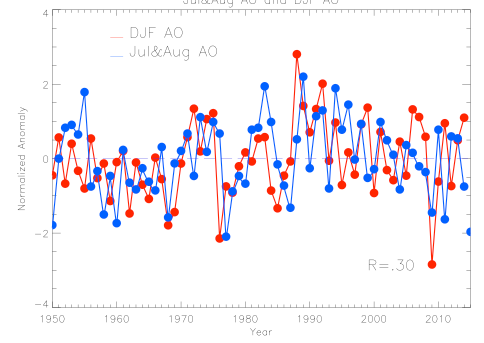
The AO, which has remained almost consistently in negative territory since late June, though more recently has trended closer to neutral after near record low AO values for July and August. The AO is predicted to first trend positive peaking over the weekend before trending negative once more. However the AO is predicted to remain negative all of next week and most of the following week. Does the strong strongly negative AO values, especially in July and August portend anything about the upcoming winter AO? In an effort to quantify how much predictive skill is inherent in the summer AO for the upcoming winter AO the time-series for the July and August AO with the following winter AO is plotted (December-February; Figure 1). Also included is the AO value for this past July and August, which was the second lowest observed since 1950. The correlation between the two time series is 0.30, a statistically significant value but the explained variance is less than 10%. The low mean AO value of this past summer negatively biases the upcoming winter AO and if an overall mean negative AO persists for much of the fall, this will likely increase the odds of a negative winter AO.
In the short term a below normal geopotential heights will dominate the central Arctic basin while the mid-latitudes are dominated by above normal geopotential heights. The main area of positive geopotential heights stretches across the North Atlantic sector from the Northeastern United States to northwestern Russia. This has resulted in warm temperatures for the Eastern United States and Northern Europe. However across Central and Southern Europe temperatures are cool relative to normal resulting from relatively low geopotential heights in the Mediterranean region and easterly flow aloft. With the exception of Alaska, warm temperatures dominate western North America as ridging continues to dominate the region.
Longer term however, a piece of the strong mid-tropospheric ridging centered over Northern Europe will break off and spin its way into the central Arctic basin. As the area of above normal geopotential heights approaches the North Pole it is predicted to also become more expansive in extent until above normal geopotential heights dominate the entire Arctic basin next week. Meanwhile the low geopotential height center near the North Pole will split into two pieces with one piece diving down into Western Siberia and the other into Eastern Canada. This reconfiguration of the geopotential heights is not only predicted to force the AO back into negative territory but to also bring a cool down in temperatures first to northern Asia and then eastern Canada. This will force the AO back into negative territory. Besides low geopotential heights across much of Northern Asia and Eastern Canada, lower geopotential heights will become more likely in regions that are favored during negative AO regimes - Europe, the Aleutians and the Eastern United States. Lower geopotential heights will result in colder temperatures for the Eastern United States and Europe. With troughing favored in Central Siberia above normal geopotential heights and above normal temperatures are predicted downstream for East Asia.
Figure 1. The time series of the July-August AO (blue curve) and the following winter (December-January-February) AO (red curve) since 1950. Also shown is the July-August 2015 AO (blue dot). The correlation value between the two time-series is 0.30.
Wie verder wil lezen: http://web.mit.edu/jlcohen/www/papers.html
Hier is van echt winterweer natuurlijk geen sprake. Te vroeg in het jaar. Maar elders op het NH wordt het langzamerhand toch witter en witter. Het is met andere woorden weer tijd om te kijken hoe het Siberische sneeuwdek er voor staat. Een leuke traditie hier op weerwoord!
Zeg je Siberisch sneeuwdek, dan denk je aan Judah Cohen. Een welbekende wetenschapper uit de VS.
Vorig jaar hebben Paul en ik een interview gehouden met Judah Cohen. Wie dat gemist heeft kijk hier http://www.vwkweb.nl/index.php?page=1325
Paul en ik hebben ontzettend veel plezier beleefd aan het interview. Wij hopen dat jullie er van kunnen genieten. De SAI/SCE heeft vorig jaar een 'tikkie' gekregen, benieuwd hoe de theorie zich verder ontwikkeld.
De welbekende Judah Cohen heeft zijn kijk op de situatie opgeschreven. Daarbij kijkt hij terug en vooruit. Hierbij de tekst.
The AO, which has remained almost consistently in negative territory since late June, though more recently has trended closer to neutral after near record low AO values for July and August. The AO is predicted to first trend positive peaking over the weekend before trending negative once more. However the AO is predicted to remain negative all of next week and most of the following week. Does the strong strongly negative AO values, especially in July and August portend anything about the upcoming winter AO? In an effort to quantify how much predictive skill is inherent in the summer AO for the upcoming winter AO the time-series for the July and August AO with the following winter AO is plotted (December-February; Figure 1). Also included is the AO value for this past July and August, which was the second lowest observed since 1950. The correlation between the two time series is 0.30, a statistically significant value but the explained variance is less than 10%. The low mean AO value of this past summer negatively biases the upcoming winter AO and if an overall mean negative AO persists for much of the fall, this will likely increase the odds of a negative winter AO.
In the short term a below normal geopotential heights will dominate the central Arctic basin while the mid-latitudes are dominated by above normal geopotential heights. The main area of positive geopotential heights stretches across the North Atlantic sector from the Northeastern United States to northwestern Russia. This has resulted in warm temperatures for the Eastern United States and Northern Europe. However across Central and Southern Europe temperatures are cool relative to normal resulting from relatively low geopotential heights in the Mediterranean region and easterly flow aloft. With the exception of Alaska, warm temperatures dominate western North America as ridging continues to dominate the region.
Longer term however, a piece of the strong mid-tropospheric ridging centered over Northern Europe will break off and spin its way into the central Arctic basin. As the area of above normal geopotential heights approaches the North Pole it is predicted to also become more expansive in extent until above normal geopotential heights dominate the entire Arctic basin next week. Meanwhile the low geopotential height center near the North Pole will split into two pieces with one piece diving down into Western Siberia and the other into Eastern Canada. This reconfiguration of the geopotential heights is not only predicted to force the AO back into negative territory but to also bring a cool down in temperatures first to northern Asia and then eastern Canada. This will force the AO back into negative territory. Besides low geopotential heights across much of Northern Asia and Eastern Canada, lower geopotential heights will become more likely in regions that are favored during negative AO regimes - Europe, the Aleutians and the Eastern United States. Lower geopotential heights will result in colder temperatures for the Eastern United States and Europe. With troughing favored in Central Siberia above normal geopotential heights and above normal temperatures are predicted downstream for East Asia.
Figure 1. The time series of the July-August AO (blue curve) and the following winter (December-January-February) AO (red curve) since 1950. Also shown is the July-August 2015 AO (blue dot). The correlation value between the two time-series is 0.30.
Wie verder wil lezen: http://web.mit.edu/jlcohen/www/papers.html
„Et nul ne se connait tant qu'il n'a pas souffert, „C'est une dure loi, mais une loi suprème, „Vieille comme le monde et la fatalité, „Qu'l nous faut du malheur regevoir le baptéme, ~Et qu'a ce triste prix tout doit étre acheté. „Les moissons pour murir out besoin de rosée, „Pour vivre et pour sentir l'homme a besoin de pleura, „La joie a pour symbole une plante brisée, „Humide encore de pluie et couverte de fleurs."