Ik kwam een interessant artikel tegen in de PNAS mailing van eind maart welke ik graag hier post met de samenvatting en significatie, tezamen met de eerste figuur uit de paper (publiek beschikbaar op de site)
Nederlandse samenvatting:
Door middel van dendrochronologie en de incidentie van schipbreuken heeft een onderzoeksgroep de historische incidentie van tropische stormen in het Caribisch gebied gereconstrueerd, met specifieke aandacht voor cycloon activiteit tijdens het Maunder minimum. Dit onderzoek is uitgevoerd om de relatie tussen instraling en tropische cycloon activiteit nader te onderzoeken. Een belangrijke bevinding is dat de verlaagde instraling tijdens het minimum leidde tot een gereduceerd aantal cyclonen. Er worden in het artikel verder aanbevelingen gedaan die de nadruk leggen op vervolg onderzoek naar het effect van instraling en klimaat verandering op oceanische (ENSO) en atmosferische (NAO) circulatie patronen.
'Shipwreck rates reveal Caribbean tropical cyclone response to past radiative forcing'
Significance
Twenty-first-century North Atlantic tropical cyclone (TC) projections are crucial for the development of adaptation and mitigation strategies, but they are subject to large uncertainties, particularly with respect to TC response to radiative forcing. We used a combination of tree-ring data and historical shipwreck data to show that TC activity in the Caribbean was distinctly suppressed during the Maunder Minimum (1645–1715 CE), a period when solar irradiance was severely reduced. This solar fingerprint on decadal-scale Caribbean TC variability implies modulation by a combination of basin-wide climatic phenomena. Our findings highlight the need to enhance our understanding of the response of atmospheric circulation patterns to radiative forcing and climate change to improve the skill of future TC projections.
Abstract
Assessing the impact of future climate change on North Atlantic tropical cyclone (TC) activity is of crucial societal importance, but the limited quantity and quality of observational records interferes with the skill of future TC projections. In particular, North Atlantic TC response to radiative forcing is poorly understood and creates the dominant source of uncertainty for twenty-first-century projections. Here, we study TC variability in the Caribbean during the Maunder Minimum (MM; 1645–1715 CE), a period defined by the most severe reduction in solar irradiance in documented history (1610–present). For this purpose, we combine a documentary time series of Spanish shipwrecks in the Caribbean (1495–1825 CE) with a tree-growth suppression chronology from the Florida Keys (1707–2009 CE). We find a 75% reduction in decadal-scale Caribbean TC activity during the MM, which suggests modulation of the influence of reduced solar irradiance by the cumulative effect of cool North Atlantic sea surface temperatures, El Niño–like conditions, and a negative phase of the North Atlantic Oscillation. Our results emphasize the need to enhance our understanding of the response of these oceanic and atmospheric circulation patterns to radiative forcing and climate change to improve the skill of future TC projections.
Figure 1 (zie onder):
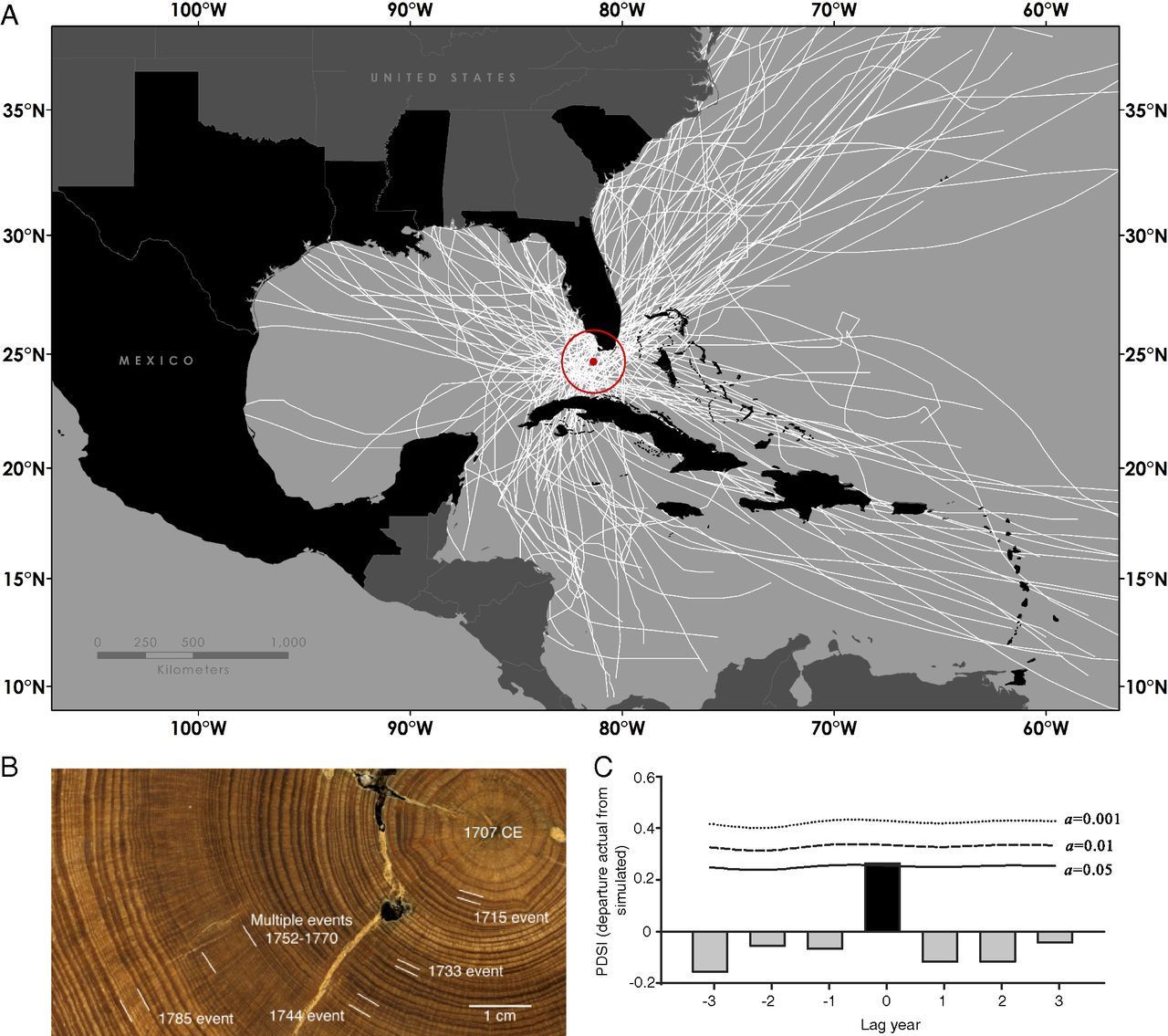
Geographical location, storm-induced tree growth suppression, and its climatic signal at Big Pine Key, Florida. (A) Geographical location of the BPK tree-ring site (red dot), HURDAT-derived (1851–2010 CE) (17) category 1–5 TCs (white lines; n = 44) that tracked within 160 km (red buffer ring) of the site, and countries/states for which shipwrecks were recorded (black shading) (16); (B) Slash pine (P. elliottii var. densa) section (dated over 1707–1829 CE) with tree-growth suppressions (multiple consecutive narrower-than-average annual rings) resulting from TC events indicated by date of recorded TC event; (C) SEA (1895–2009 CE) of TCsupp event series (defined as years when >75% of samples showed growth suppression; n = 12) with July–November Palmer Drought Severity Index (PDSI) for Florida climate division 7.
Nederlandse samenvatting:
Door middel van dendrochronologie en de incidentie van schipbreuken heeft een onderzoeksgroep de historische incidentie van tropische stormen in het Caribisch gebied gereconstrueerd, met specifieke aandacht voor cycloon activiteit tijdens het Maunder minimum. Dit onderzoek is uitgevoerd om de relatie tussen instraling en tropische cycloon activiteit nader te onderzoeken. Een belangrijke bevinding is dat de verlaagde instraling tijdens het minimum leidde tot een gereduceerd aantal cyclonen. Er worden in het artikel verder aanbevelingen gedaan die de nadruk leggen op vervolg onderzoek naar het effect van instraling en klimaat verandering op oceanische (ENSO) en atmosferische (NAO) circulatie patronen.
'Shipwreck rates reveal Caribbean tropical cyclone response to past radiative forcing'
Significance
Twenty-first-century North Atlantic tropical cyclone (TC) projections are crucial for the development of adaptation and mitigation strategies, but they are subject to large uncertainties, particularly with respect to TC response to radiative forcing. We used a combination of tree-ring data and historical shipwreck data to show that TC activity in the Caribbean was distinctly suppressed during the Maunder Minimum (1645–1715 CE), a period when solar irradiance was severely reduced. This solar fingerprint on decadal-scale Caribbean TC variability implies modulation by a combination of basin-wide climatic phenomena. Our findings highlight the need to enhance our understanding of the response of atmospheric circulation patterns to radiative forcing and climate change to improve the skill of future TC projections.
Abstract
Assessing the impact of future climate change on North Atlantic tropical cyclone (TC) activity is of crucial societal importance, but the limited quantity and quality of observational records interferes with the skill of future TC projections. In particular, North Atlantic TC response to radiative forcing is poorly understood and creates the dominant source of uncertainty for twenty-first-century projections. Here, we study TC variability in the Caribbean during the Maunder Minimum (MM; 1645–1715 CE), a period defined by the most severe reduction in solar irradiance in documented history (1610–present). For this purpose, we combine a documentary time series of Spanish shipwrecks in the Caribbean (1495–1825 CE) with a tree-growth suppression chronology from the Florida Keys (1707–2009 CE). We find a 75% reduction in decadal-scale Caribbean TC activity during the MM, which suggests modulation of the influence of reduced solar irradiance by the cumulative effect of cool North Atlantic sea surface temperatures, El Niño–like conditions, and a negative phase of the North Atlantic Oscillation. Our results emphasize the need to enhance our understanding of the response of these oceanic and atmospheric circulation patterns to radiative forcing and climate change to improve the skill of future TC projections.
Figure 1 (zie onder):
Geographical location, storm-induced tree growth suppression, and its climatic signal at Big Pine Key, Florida. (A) Geographical location of the BPK tree-ring site (red dot), HURDAT-derived (1851–2010 CE) (17) category 1–5 TCs (white lines; n = 44) that tracked within 160 km (red buffer ring) of the site, and countries/states for which shipwrecks were recorded (black shading) (16); (B) Slash pine (P. elliottii var. densa) section (dated over 1707–1829 CE) with tree-growth suppressions (multiple consecutive narrower-than-average annual rings) resulting from TC events indicated by date of recorded TC event; (C) SEA (1895–2009 CE) of TCsupp event series (defined as years when >75% of samples showed growth suppression; n = 12) with July–November Palmer Drought Severity Index (PDSI) for Florida climate division 7.
Alles komt op zijn eigen tijd