Begint die op volle toeren te raken.
Judah Cohen beschrijft in zijn blog drie mogelijkheden.
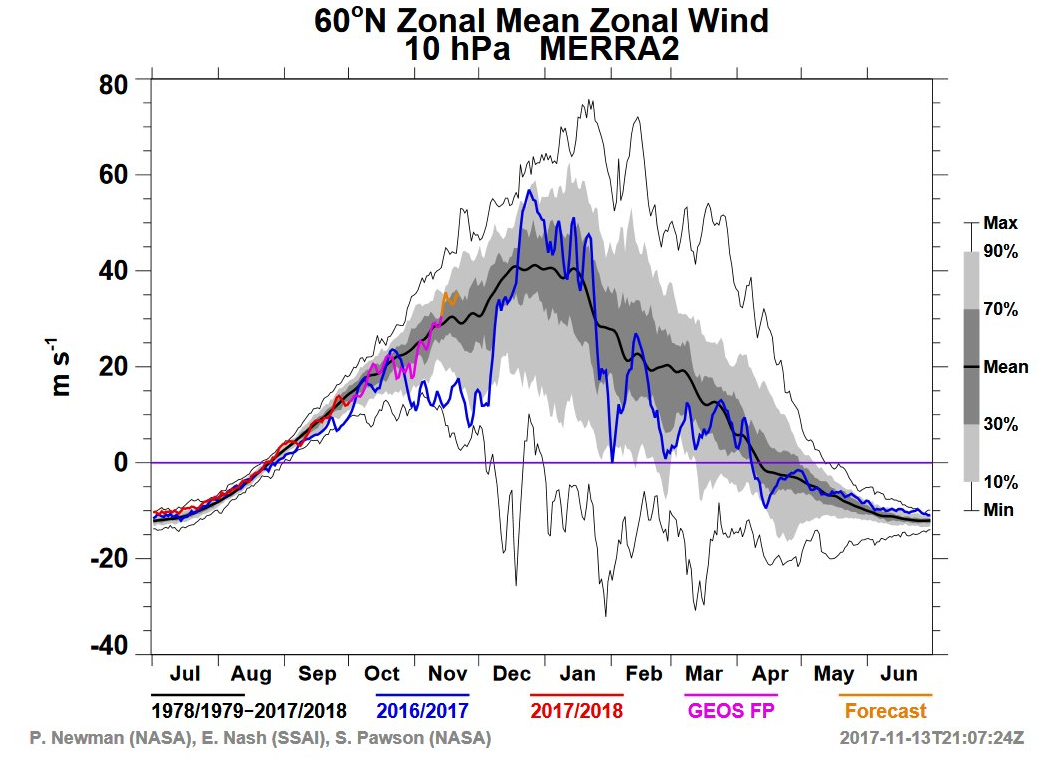
Last week I discussed two possible scenarios but actually after some more thought I believe that there are three: one where the troposphere and stratosphere remain uncoupled (the circulation in each sphere are divergent or opposite) and two where the troposphere and stratosphere become coupled (where the circulations are similar or mirror each other). There are of course other possible scenarios but they are all variations of the three presented. The first scenario could result where the WAFz or poleward heat transport remains quiet for an extended period. In this scenario little changes in both the troposphere and the stratosphere with the troposphere remaining perturbed while a relatively strong PV persists in the stratosphere. A good example of this scenario is winter 1995/96 and to a lesser degree winter 2010/11. The other two scenarios involve troposphere and stratosphere coupling and a period of more active WAFz or poleward heat transport. The first is where the WAFz becomes active but instead of being directed towards the North Pole it is directed to the equator. This would result in a further strengthening of the stratospheric PV that eventually couples to the troposphere leading to an extended period of a positive tropospheric AO, mostly zonal flow and relatively mild conditions across the NH mid-latitude continents. The second is where the WAFz becomes active which is directed towards the North Pole leading to a weakening of the stratospheric PV. Initially this could result in a relatively mild period for the NH but eventually the PV disruption couples with the troposphere resulting in increased high latitude blocking and a relatively cold pattern across the NH mid-latitude continents. It is hard to know which scenario is favored but the easterly Quasi-Biennial Oscillation (QBO) should favor the latter scenario if and when the WAFz becomes more active.