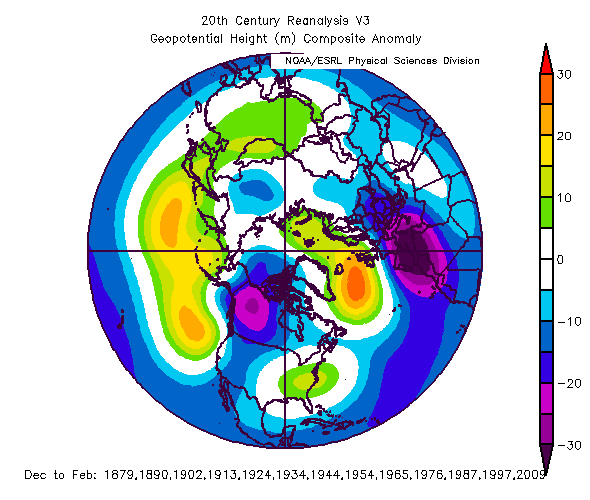
Ik heb van Reinout een mail gekregen dat hij 16 november hierover meer duidelijkheid verschaft over hoe WCS hier naar kijkt. WCS is het bedrijf dat de seizoensverwachtingen maakt.
Overigens verwijs ik naar het artikel dat Paul gisteren liet zien en een plaatje van de luchtdrukafwijking bij weinig zonnevlekken.
Ik heb het vaker over deze studie gehad. O.a. reeds in 2014. Zie:
http://www.weerwoord.be/m/2030325 Met daarbij de opmerking dat een jaren met positieve NAO waarschijnlijk was.
Tenslotte nog deze studie:
The 11?year solar cycle signal in December–January–February (DJF) averaged mean?sea?level pressure (SLP) and Atlantic/European blocking frequency is examined using multilinear regression with indices to represent variability associated with the solar cycle, volcanic eruptions, the El Niño–Southern Oscillation (ENSO) and the Atlantic Multidecadal Oscillation (AMO). Results from a previous 11?year solar cycle signal study of the period 1870–2010 (140 years; ∼13 solar cycles) that suggested a 3–4 year lagged signal in SLP over the Atlantic are confirmed by analysis of a much longer reconstructed dataset for the period 1660–2010 (350 years; ∼32 solar cycles). Apparent discrepancies between earlier studies are resolved and stem primarily from the lagged nature of the response and differences between early? and late?winter responses. Analysis of the separate winter months provide supporting evidence for two mechanisms of influence, one operating via the atmosphere that maximises in late winter at 0–2 year lags and one via the mixed?layer ocean that maximises in early winter at 3–4 year lags. Corresponding analysis of DJF?averaged Atlantic/European blocking frequency shows a highly statistically significant signal at ∼1?year lag that originates primarily from the late winter response. The 11?year solar signal in DJF blocking frequency is compared with other known influences from ENSO and the AMO and found to be as large in amplitude and have a larger region of statistical significance.
http://rmets.onlinelibrary.wiley.com/doi/10.1002/qj.2782