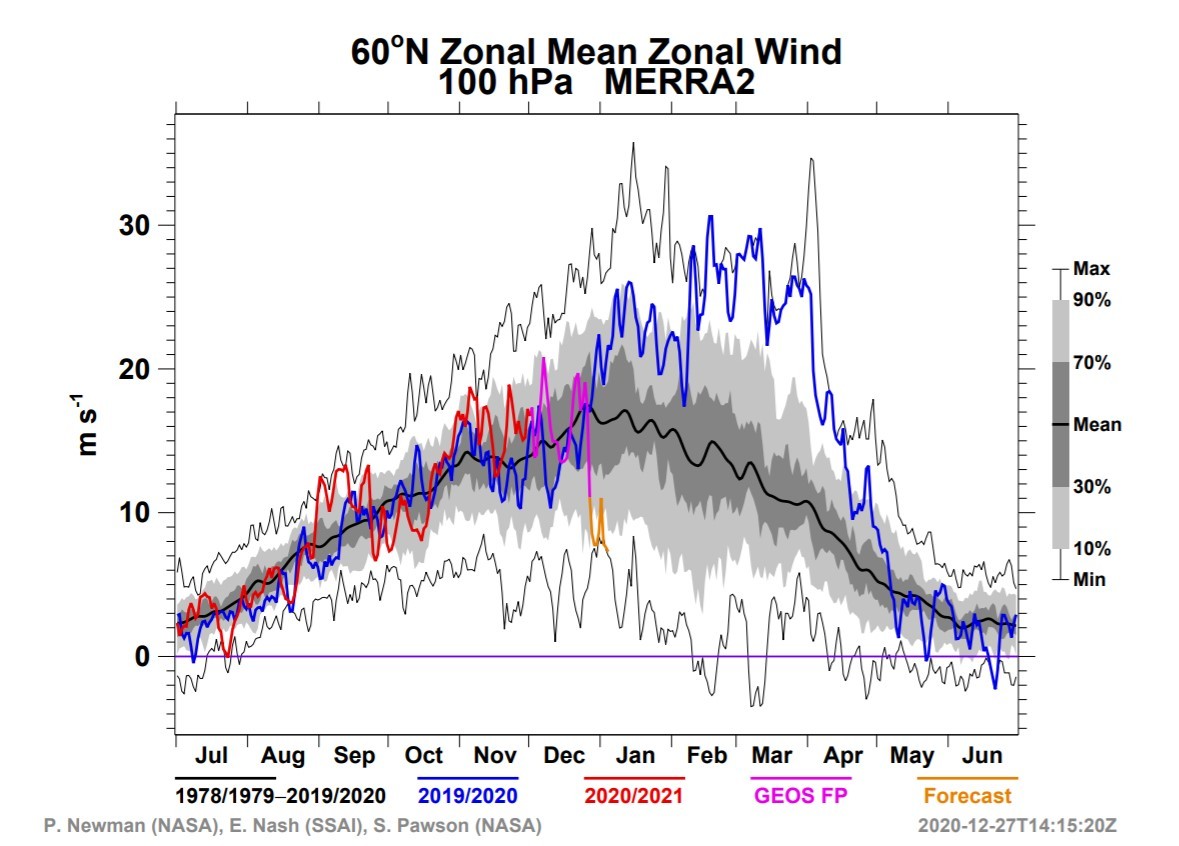
Even without a major sudden warming event (defined at 10 hPa) the lower stratospheric vortex is heading toward record-weak territory - opposite to this time last year! This will favour Greenland blocking regimes.
http://agupubs.onlinelibrary.wiley.com/doi/10.1029/2019GL085592
http://rmets.onlinelibrary.wiley.com/doi/abs/10.1002/qj.3280
Iets om over na te denken ivm discussie zien we in GFS effecten SSW. Hoe ik de tweet lees, komt het effect (meer nadruk op GL hoog) niet zozeer als effect van de SSW (negatieve wind def 60N, 10 hPa).
--------------------------------------------------------------------------------------------------------------
Stratosphere–troposphere coupling is often viewed from the perspective of the annular modes and their dynamics. Despite the obvious benefits of this approach, recent work has emphasised the greater tropospheric sensitivity to stratospheric variability in the Atlantic basin than in the Pacific basin. In this study, a new approach to understanding stratosphere–troposphere coupling is proposed, with a focus on the influence of the stratospheric state on North Atlantic weather regimes (during extended winter, November to March). The influence of the strength of the lower?stratospheric vortex on four commonly used tropospheric weather regimes is quantified. The negative phase of the North Atlantic Oscillation is most sensitive to the stratospheric state, occurring on 33% of days following weak vortex conditions but on only 5% of days following strong vortex conditions. An opposite and slightly weaker sensitivity is found for the positive phase of the North Atlantic Oscillation and the Atlantic Ridge regime. For the North Atlantic Oscillation regimes, stratospheric conditions change both the probability of remaining in each regime and the probability of transitioning to that regime from others. A logistic regression model is developed to further quantify the sensitivity of tropospheric weather regimes to the lower stratospheric state. The logistic regression model predicts an increase of 40–60% in the probability of transition to the negative phase of the North Atlantic Oscillation for a one standard deviation reduction in the strength of the stratospheric vortex. Similarly it predicts a 10–30% increase in the probability of transition to the positive phase of the North Atlantic Oscillation for a one standard deviation increase in the strength of the stratospheric vortex. The stratosphere–troposphere coupling in the European Centre for Medium?range Weather Forecasts Integrated Forecasting System model is found to be consistent with the re?analysis data by fitting the same logistic regression model.
Abstract
The impact of the Arctic stratospheric polar vortex on persistent weather regimes over North America is so far underexplored. Here we show the relationship between four wintertime North American weather regimes and the stratospheric vortex strength using reanalysis data. We find that the strength of the vortex significantly affects the behavior of the regimes. While a regime associated with Greenland blocking is strongly favored following weak vortex events, it is not the primary regime associated with a widespread, elevated risk of extreme cold in North America. Instead, we find that the regime most strongly associated with widespread extremely cold weather does not show a strong dependency on the strength of the lower stratospheric zonal mean zonal winds. We also suggest that stratospheric vortex morphology may be particularly important for cold air outbreaks during this regime.