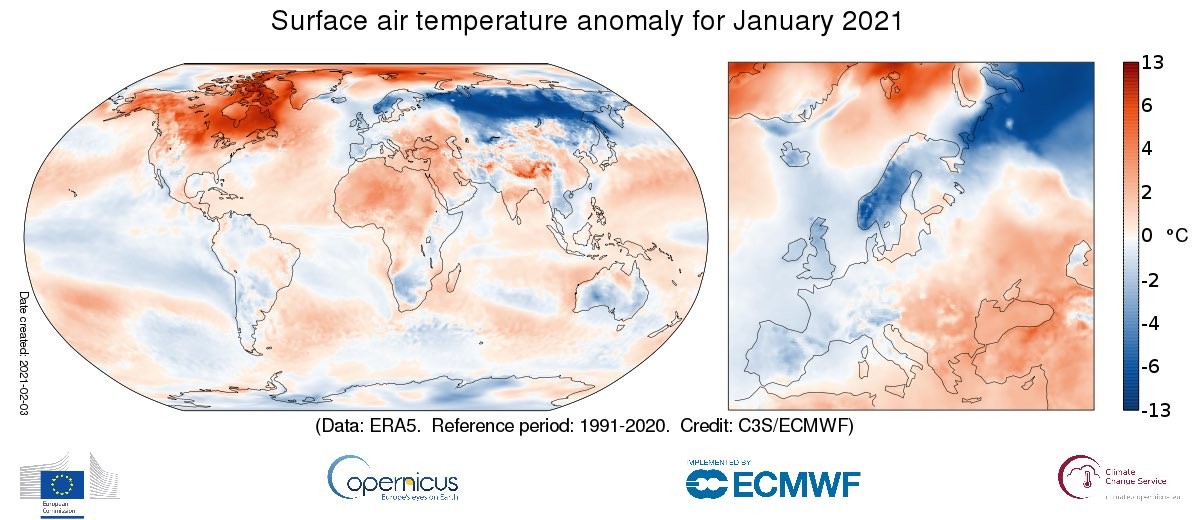
January 2021 was colder than the new 1991-2020 climatological reference for January over the west and most of the north of Europe, particularly over southern Norway, central Sweden and the far north-west of Russia. Norway as a whole experienced its coldest January since 2010, with a temperature 3.3°C below the 1991-2020 average. One station recorded more than 10°C below its average. In contrast, it was warmer than the 1991-2020 average over the east and south-east of the continent. The first ten days of the month are reported to have been the warmest in a 160-year record for Athens.
Elsewhere, the largest differences from the 1991-2020 climate were also at high northern latitudes. It was much colder than average over a large swathe of Siberia, and much warmer than average over large parts of Alaska, Canada and Greenland, the Barents and Kara Seas and the Arctic Ocean to the the north.
Other regions with well above-average temperatures include North Africa, the Middle East and the Tibetan Plateau, continuing what was reported during December and the boreal autumn of 2020. Other land areas show a mix of above- and below-average temperatures, with notably cool conditions in the Southern Hemisphere, especially over southern Africa, southern Australia and parts of Antarctica.
Air temperatures remained relatively high over the much of the North Pacific Ocean and over the Atlantic to the east of Canada. Marine air temperatures were also above average east of Argentina, over parts of the Indian Ocean and over the central southern Pacific. Relatively cool La Niña conditions persisted over the tropical eastern and central Pacific, and temperatures were also below average over the subtropical south-eastern Pacific, in several places over the extratropical oceans of the Southern Hemisphere, and over other parts of the Atlantic, Pacific and Indian Oceans. http://climate.copernicus.eu/surface-air-temperature-january-2021