in 536 ergens in het noorden, in 540 Krakatau? (video)
Bericht van: Eric, Rotterdam , 23-01-2022 12:34Ask medieval historian Michael McCormick what year was the worst to be alive, and he's got an answer: "536." Not 1349, when the Black Death wiped out half of Europe. Not 1918, when the flu killed 50 million to 100 million people, mostly young adults. But 536. In Europe, "It was the beginning of one of the worst periods to be alive, if not the worst year," says McCormick, a historian and archaeologist who chairs the Harvard University Initiative for the Science of the Human Past.
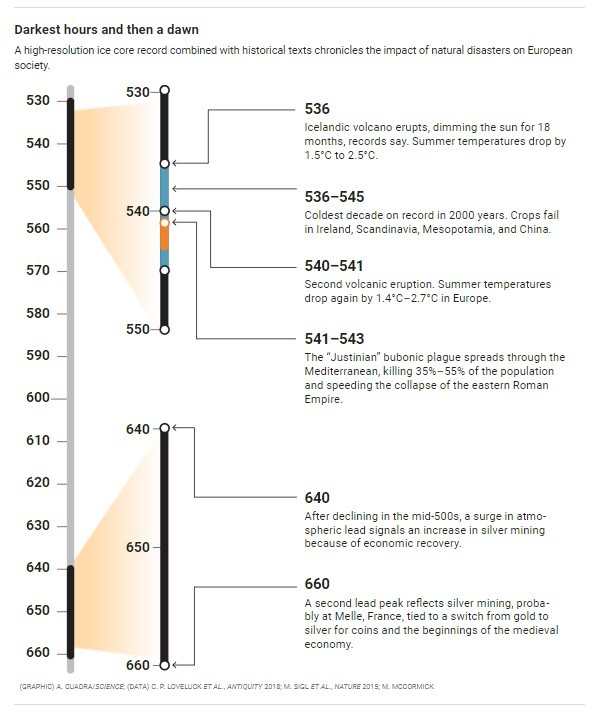
A mysterious fog plunged Europe, the Middle East, and parts of Asia into darkness, day and night—for 18 months. "For the sun gave forth its light without brightness, like the moon, during the whole year," wrote Byzantine historian Procopius. Temperatures in the summer of 536 fell 1.5°C to 2.5°C, initiating the coldest decade in the past 2300 years. Snow fell that summer in China; crops failed; people starved. The Irish chronicles record "a failure of bread from the years 536–539." Then, in 541, bubonic plague struck the Roman port of Pelusium, in Egypt. What came to be called the Plague of Justinian spread rapidly, wiping out one-third to one-half of the population of the eastern Roman Empire and hastening its collapse, McCormick says.
By matching the ice record of these chemical traces with tree ring records of climate, a team led by Michael Sigl, now of the University of Bern, found that nearly every unusually cold summer over the past 2500 years was preceded by a volcanic eruption. A massive eruption—perhaps in North America, the team suggested—stood out in late 535 or early 536; another followed in 540. Sigl's team concluded that the double blow explained the prolonged dark and cold.
Mayewski and his interdisciplinary team decided to look for the same eruptions in an ice core drilled in 2013 in the Colle Gnifetti Glacier in the Swiss Alps. The 72-meter-long core entombs more than 2000 years of fallout from volcanoes, Saharan dust storms, and human activities smack in the center of Europe. The team deciphered this record using a new ultra–high-resolution method, in which a laser carves 120-micron slivers of ice, representing just a few days or weeks of snowfall, along the length of the core. Each of the samples—some 50,000 from each meter of the core—is analyzed for about a dozen elements. The approach enabled the team to pinpoint storms, volcanic eruptions, and lead pollution down to the month or even less, going back 2000 years, says UM volcanologist Andrei Kurbatov.
In ice from the spring of 536, UM graduate student Laura Hartman found two microscopic particles of volcanic glass. By bombarding the shards with x-rays to determine their chemical fingerprint, she and Kurbatov found that they closely matched glass particles found earlier in lakes and peat bogs in Europe and in a Greenland ice core. Those particles in turn resembled volcanic rocks from Iceland. The chemical similarities convince geoscientist David Lowe of The University of Waikato in Hamilton, New Zealand, who says the particles in the Swiss ice core likely came from the same Icelandic volcano. But Sigl says more evidence is needed to convince him that the eruption was in Iceland rather than North America.
Either way, the winds and weather systems in 536 must have been just right to guide the eruption plume southeast across Europe and, later, into Asia, casting a chilly pall as the volcanic fog "rolled through," Kurbatov says. The next step is to try to find more particles from this volcano in lakes in Europe and Iceland, in order to confirm its location in Iceland and tease out why it was so devastating.
..
Why 536 was ‘the worst year to be alive' | Science | AAAS
Fascinerend.