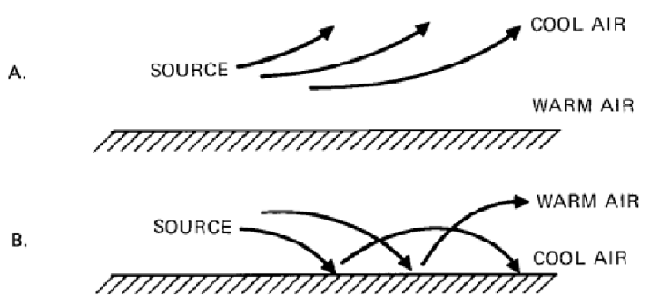
De wind en de luchttemperatuur hebben op afstanden van meer dan 100 meter grote invloed.
Een verticale temperatuurgradiënt (waarbij het op grotere hoogte kouder is of juist warmer) heeft effect. Bij een inversie buigt geluid naar beneden en draagt veel verder, waardoor zones van abnormale hoorbaarheid voor kunnen komen.
https://nl.m.wikipedia.org/wiki/Geluidsvoortplanting
Temperature gradients also influence the propagation of sound waves over long distances. Indeed, temperature influences the density of the air, which in turn influences the speed of sound. For air, which is considered a perfect gas, the lower the temperature, the higher the density and the lower the velocity. This decrease in speed is accompanied by a change in the trajectory of the sound waves: they are refracted. The refraction of sound waves is similar to the refraction of light.
https://www.softdb.com/blog/effect-of-wind-and-temperature-gradients-on-sound-waves/