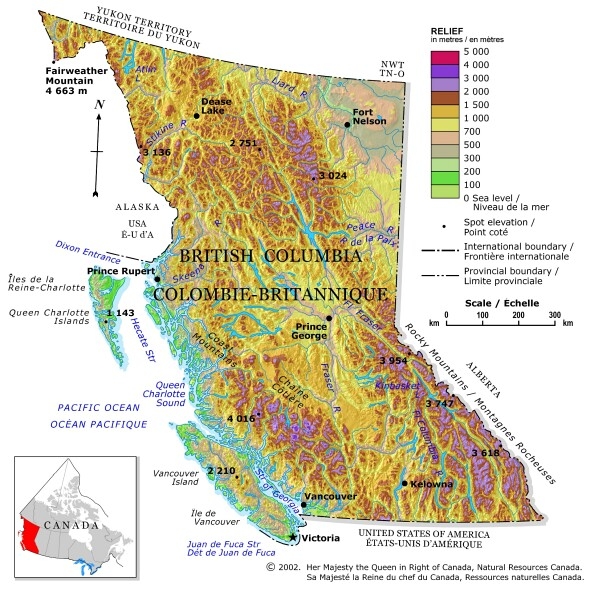
De orografie (zie bijgevoegd plaatje) zal ook wel een invloed hebben op de windrichtingen, maar het is wel opvallend idd.
Heb je trouwens ook naar de gusts gekeken?
Misschien maar ff een klimaatatlasje van Canada opzoeken, voor de grootschalige verdeling van luchtmassa's en drukgebieden.
Trouwens van Wikipedia:
Bron: http://en.wikipedia.org/wiki/Vancouver
Heb je trouwens ook naar de gusts gekeken?
Misschien maar ff een klimaatatlasje van Canada opzoeken, voor de grootschalige verdeling van luchtmassa's en drukgebieden.
Trouwens van Wikipedia:
Vancouver's climate is unusually temperate by Canadian standards; after Victoria, it is the second warmest major city in Canada during the winter, which explains why it is ranked as the second most desirable climate in Canada. Summer months are generally sunny and dry, temperatures moderate, with the daily maximum averaging 22°C in July and August, but this is due to the influence of the Burrard Inlet and the Strait of Georgia, as the more easterly suburbs are hotter in the summer. Thunderstorms are very infrequent due to the cool waters of the Pacific Ocean, but they can occur at any time of the year. Spring and autumn are usually showery and cool. Rainfall is frequent in winter. Snow occurs in the surrounding mountains but less often at sea level, though there are winters in which the city receives enough snowfall to cause school closures. Blizzards are rare but can incapacitate much of the Lower Mainland. One in 1996 resulted in over 60 cm of snow in Vancouver. The system was responsible for millions of dollars in damage.
Although Vancouver is popularly known as the rainy city, only 166 days per year have measurable precipitation on average, and 289 days per year have measurable sunshine. In fact, every major city from Quebec City eastward to St. John's gets more annual precipitation than Vancouver. For a few nights near the summer solstice each June, the northern sky remains slightly lit by the sun, and nighttime lasts only about 6 hours.
Bron: http://en.wikipedia.org/wiki/Vancouver
Bericht laatst bijgewerkt: 02-12-2005 14:42
Uitleg Wetterzentrale-kaarten (klikbaar )
)
