Laat alleen de samenstelling en dikte van de atmosfeer, de configuratie van de continenten en allerlei andere geologische factoren dit hele plaatje compliceren. De temperatuur zou onder huidige omstandigheden wellicht helemaal niet meer tot 22 graden omhoog kunnen. Bovendien is dit plaatje ernstig overgesimplificeerd, het 'equibilibrium' lag toen alles behalve nagenoeg constant op precies die waarde.
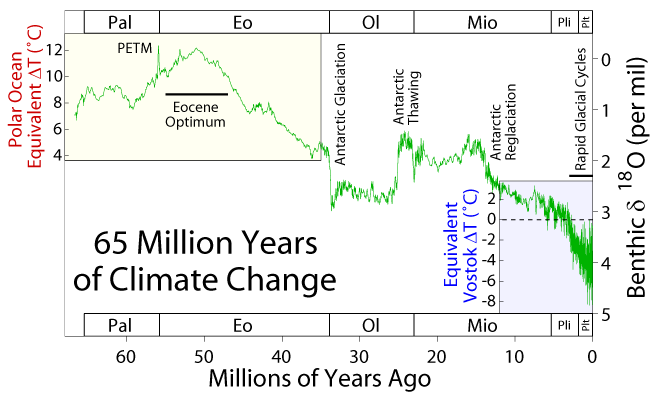
Onderstaand figuur geeft een wat preciezer beeld van het vermoedelijke, ruwe temperatuurverloop gedurende de afgelopen miljoenen jaren. Bronnen:
Lisiecki, L. E., and M. E. Raymo (2005). "A Pliocene-Pleistocene stack of 57 globally distributed benthic δ18O records". Paleoceanography 20: PA1003.
etit J.R., Jouzel J., Raynaud D., Barkov N.I., Barnola J.M., Basile I., Bender M., Chappellaz J., Davis J., Delaygue G., Delmotte M., Kotlyakov V.M., Legrand M., Lipenkov V., Lorius C., Pépin L., Ritz C., Saltzman E., Stievenard M. (1999). "Climate and Atmospheric History of the Past 420,000 years from the Vostok Ice Core, Antarctica". Nature 399: 429-436.
Zachos, James, Mark Pagani, Lisa Sloan, Ellen Thomas, and Katharina Billups (2001). "Trends, Rhythms, and Aberrations in Global Climate 65 Ma to Present". Science 292 (5517): 686–693.
Zie ook hier en hier.
Gr. Ben
Onderstaand figuur geeft een wat preciezer beeld van het vermoedelijke, ruwe temperatuurverloop gedurende de afgelopen miljoenen jaren. Bronnen:
Lisiecki, L. E., and M. E. Raymo (2005). "A Pliocene-Pleistocene stack of 57 globally distributed benthic δ18O records". Paleoceanography 20: PA1003.
etit J.R., Jouzel J., Raynaud D., Barkov N.I., Barnola J.M., Basile I., Bender M., Chappellaz J., Davis J., Delaygue G., Delmotte M., Kotlyakov V.M., Legrand M., Lipenkov V., Lorius C., Pépin L., Ritz C., Saltzman E., Stievenard M. (1999). "Climate and Atmospheric History of the Past 420,000 years from the Vostok Ice Core, Antarctica". Nature 399: 429-436.
Zachos, James, Mark Pagani, Lisa Sloan, Ellen Thomas, and Katharina Billups (2001). "Trends, Rhythms, and Aberrations in Global Climate 65 Ma to Present". Science 292 (5517): 686–693.
Zie ook hier en hier.


Gr. Ben