Hier twee onderzoekjes naar "extratropical cyclones"
Bericht van: Bas C. (Zürich, CH) , 16-10-2007 16:14Tropical Cyclone–Like Vortices in the Extratropics: Observational Evidence and Synoptic Analysis
Hier het laatste stukje uit het abstract, waar men ingaat op de cases van 3 en 10 oktober 1996.
Other remarkable features include very strong horizontal shear in the midtroposphere, and simultaneous lack of vertical shear; increasing low-level vorticity at the expenses of upper-level vorticity; creation of a low-level vorticity maximum; and finally strong low-level convergence and upper-level divergence during the onset and development of each cyclone.
The hurricane-like Mediterranean cyclone of January 1995 Ook hier een stukje uit het abstract waar men duidelijk concludeert dat baroclinische instabiliteit geen grote rol speelde bij de vorming van deze cycloon.
The investigation of the cyclone's characteristics gave strong evidence (including an eye and a warm core) to support the initial assertion that it was similar to tropical cyclones and some polar lows. Baroclinic instability does not seem particularly important, although the cyclone formed at the edge of a baroclinic zone. A numerical experiment showed the vortex did not develop in the absence of surface heat and moisture fluxes. Another experiment showed that sensible and latent heat fluxes were equally important in its development.
Groeten,
Bas
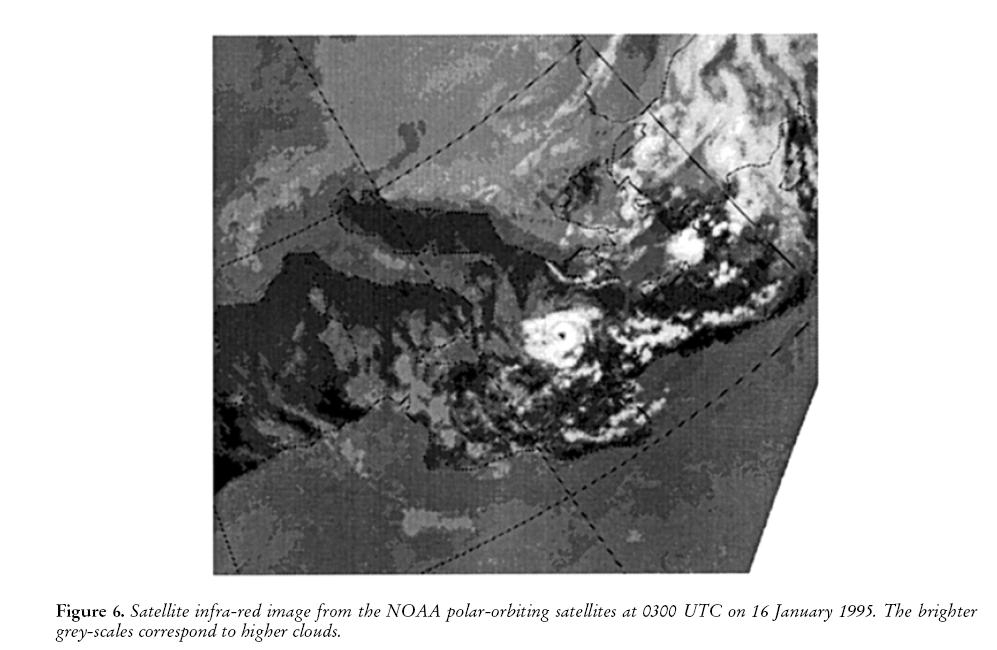
ps. Heb zelf helaas geen tijd om het uitgebreid door te nemen, maar dat komt later nog wel eens. Voor nu heb ik het even gedaan met de abstracts en even wat plaatjes gekeken. ;)D'r zitten mooi bij, zoals deze van de cycloon van 16 januari 1995:
Bron afbeelding: The hurricane-like Mediterranean cyclone of January 1995 - Ioannis Pytharoulis, George C Craig, Susan P Ballard