In 't kort: Leeftijd van het ijs.
In 't lang en in 't Engels:
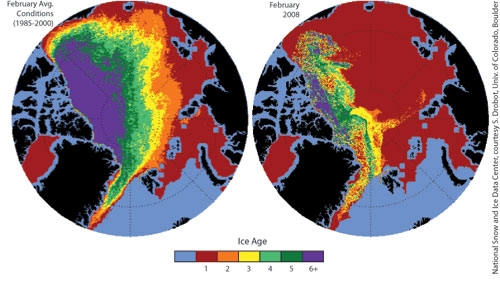
Left: February ice age distribution in the Arctic during normal conditions (1985-2000 average). Right: February 2008 Arctic ice age distribution. The ice in the Arctic is much younger than normal, with vast regions now covered by first-year ice (ice that has formed since last summer’s melt) and much less area covered by multiyear ice (ice that has survived at least one melt season). Ice that is 6 years old or older shows an even more dramatic decrease in 2008 compared to average conditions. Ice age is a good indicator of general ice thickness, with older ice thicker on average than younger ice. First-year ice generally ranges between about 3-5 feet thick, while multiyear ice averages about 8-10 feet; old ice that has survived several melt seasons can easily be 12-15 feet thick.
Bron: NASA, NSIDC en S. Drobot, University of Colorado, Boulder
In 't lang en in 't Engels:
Left: February ice age distribution in the Arctic during normal conditions (1985-2000 average). Right: February 2008 Arctic ice age distribution. The ice in the Arctic is much younger than normal, with vast regions now covered by first-year ice (ice that has formed since last summer’s melt) and much less area covered by multiyear ice (ice that has survived at least one melt season). Ice that is 6 years old or older shows an even more dramatic decrease in 2008 compared to average conditions. Ice age is a good indicator of general ice thickness, with older ice thicker on average than younger ice. First-year ice generally ranges between about 3-5 feet thick, while multiyear ice averages about 8-10 feet; old ice that has survived several melt seasons can easily be 12-15 feet thick.
Bron: NASA, NSIDC en S. Drobot, University of Colorado, Boulder
Bericht laatst bijgewerkt: 21-03-2008 10:46
 Bedankt!