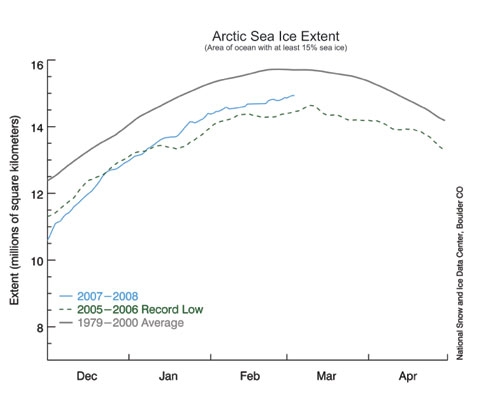
Daily timeseries of total Arctic sea ice extent (defined as the region covered by at least 15 percent ice). The ice growth through the winter has been faster than in some recent years and the extent has been above the previous lowest winter amounts that occurred during 2005-2006. However, the sea ice extent is still well below the long-term average (1979-2000), by about 250,000 square miles, an area nearly the size of the state of Texas. While the ice extent may continue growing for a little while longer, the maximum winter extent is being neared and this will clearly be a winter with well below normal ice extent.
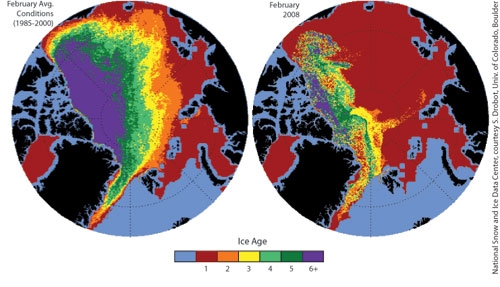
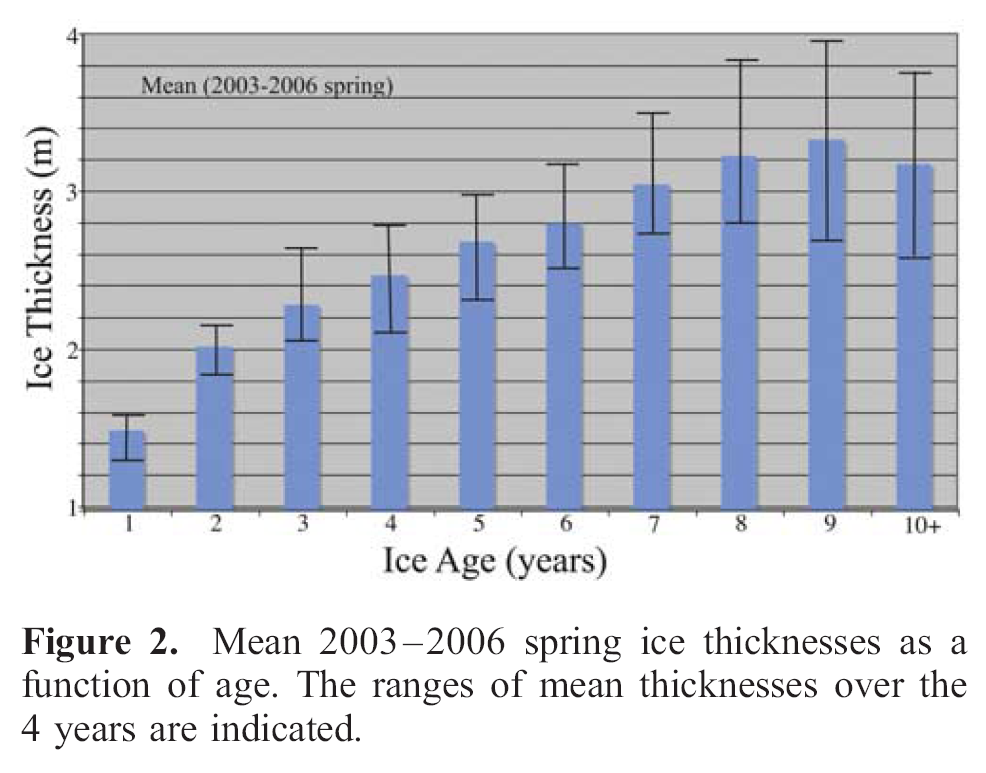
Left: February ice age distribution in the Arctic during normal conditions (1985-2000 average). Right: February 2008 Arctic ice age distribution. The ice in the Arctic is much younger than normal, with vast regions now covered by first-year ice (ice that has formed since last summer’s melt) and much less area covered by multiyear ice (ice that has survived at least one melt season). Ice that is 6 years old or older shows an even more dramatic decrease in 2008 compared to average conditions. Ice age is a good indicator of general ice thickness, with older ice thicker on average than younger ice. First-year ice generally ranges between about 3-5 feet thick, while multiyear ice averages about 8-10 feet; old ice that has survived several melt seasons can easily be 12-15 feet thick.
Bronnen: NASA, NSIDC, S. Drobot, University of Colorado, Boulder, AGU, Masnalik et al., 2007