Drie interessante links
http://www.mssl.ucl.ac.uk/www_solar/meetings/visitors_talks/lockwood.pdf Presentatie door Lockwood
Abstract
Solar activity during the current sunspot minimum has fallen to levels unknown since the start of the 20th century. The Maunder minimum (about 1650–1700) was a prolonged episode of low solar activity which coincided with more severe winters in the United Kingdom and continental Europe. Motivated by recent relatively cold winters in the UK, we investigate the possible connection with solar activity. We identify regionally anomalous cold winters by detrending the
Central England temperature (CET) record using reconstructions of the northern hemisphere
mean temperature. We show that cold winter excursions from the hemispheric trend occur more commonly in the UK during low solar activity, consistent with the solar influence on the occurrence of persistent blocking events in the eastern Atlantic. We stress that this is a regional and seasonal effect relating to European winters and not a global effect. Average solar activity has declined rapidly since 1985 and cosmogenic isotopes suggest an 8% chance of a return to Maunder minimum conditions within the next 50 years (Lockwood 2010 Proc. R. Soc. A 466
303–29): the results presented here indicate that, despite hemispheric warming, the UK and
Europe could experience more cold winters than during recent decades.
http://iopscience.iop.org/1748-9326/5/2/024001/pdf/1748-9326_5_2_024001.pdf Beroemde artikel van hem
http://www.met.reading.ac.uk/~swr01tjw/pubs/solar.pdf
4. Discussion
We have shown that using the open solar flux, derived from geomagnetic activity, as a measure of solar activity gives stronger correlations with atmospheric circulation than obtained with the onventionally-used solar activity indices. The relation is also simpler,
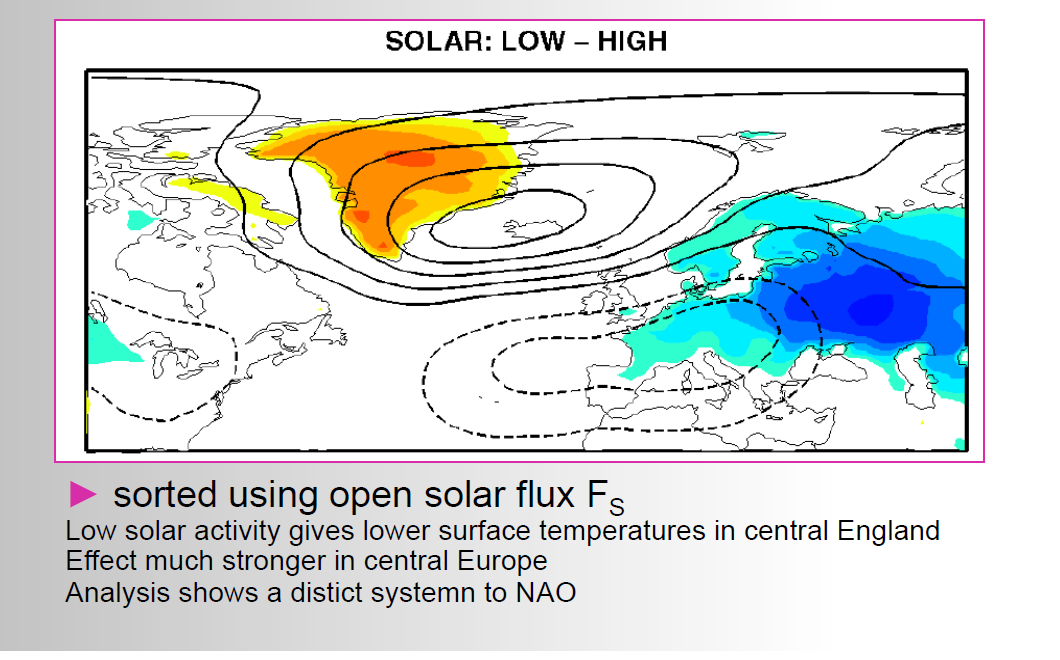
being largely (but not completely) linear between high- and low-solar winters. While anomalous circulation is seen around the globe in response to solar variability it is particularly enhanced over the North Atlantic and Eurasia, where the difference in surface temperature between high- and low-solar winters is of the order of a few degrees and the
circulation anomalies are of the same order as the standard deviation of the NAO. This is perhaps not too surprising given the unique configuration of the North Atlantic jet stream which makes it particularly susceptible to forcing. This strong regional response
may shed some light onto the apparent solar signal in Atlantic/European paleoclimate records (e.g. Bond et al. 2001; Hormes et al. 2006). These findings suggest that solar variability could provide a valuable source of skill for decadal climate prediction. The
atmospheric circulation response to solar forcing also provides a valuable test case with which to evaluate the skill of climate models in simulating the response to changes in external forcing.
One proposed mechanism for solar variability to influence the lower stratosphere is via a modulation of the vertical propagation of planetary waves into the stratosphere in wintertime (Kodera and Kuroda 2002; Gray et al. 2004). These influence the variability of the stratosphere and hence the troposphere via the NAO/NAM. This is the so-called
‘polar route’ of stratospheric influence (see e.g. Gray et al. 2010). The circulation response to solar forcing shown here certainly includes a strong Atlantic jet stream response which is very well described by the NAO. However, it also appears to have a signature which is distinct from the NAO. The circulation pattern is weighted more towards the eastern part of the North Atlantic and features a pronounced extension into Eurasia. Similarly, the
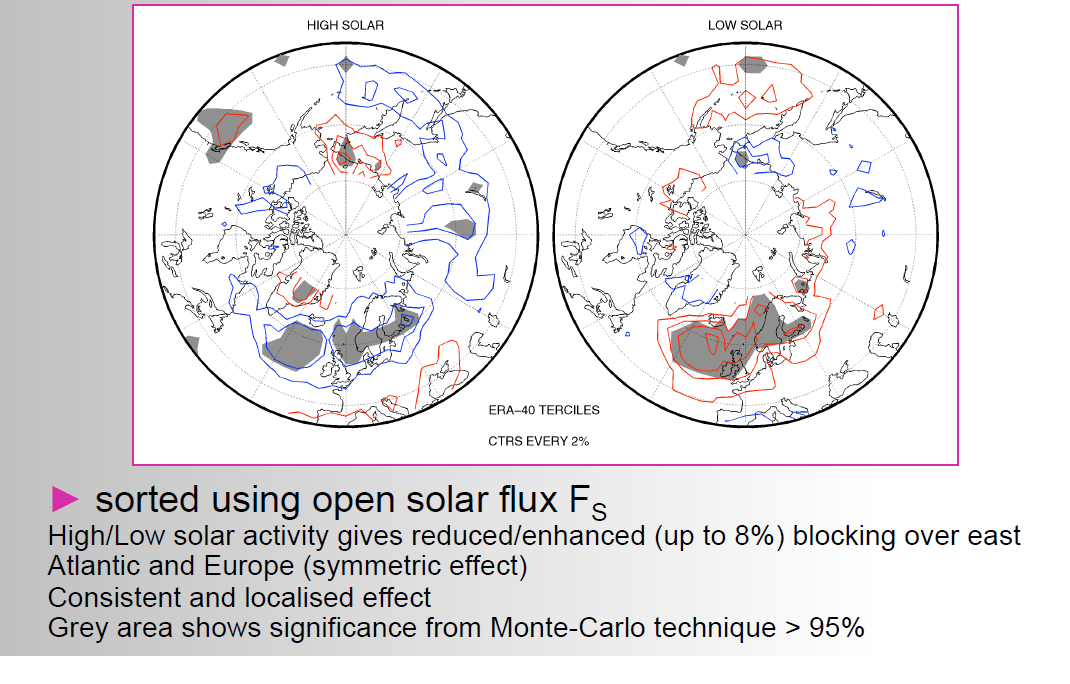
changes in blocking are limited to the East Atlantic and extend into Scandinavia, while variations in blocking associated with the NAO are centred in theWest Atlantic (Woollings et al. 2008). This distinct signature may be useful for the detection and attribution of observed changes in circulation. It also acts to focus attention on certain dynamical
mechanisms, for example on the LC1-type anticyclonic Rossby wave-breaking which is more common towards the downstream end of the storm track (e.g. Martius et al. 2007). The signature in blocking is markedly different from that which Woollings et al. [2010]
found to lag variations in the stratospheric polar vortex. This suggests that the direct influence of changes in tropical lower stratospheric temperatures on the refraction of storm track eddies could be important, as demonstrated by Simpson et al. [2009], especially since Fs also shows stronger links with these lower stratospheric temperatures (Lockwood et al. 2010b).
http://www.mssl.ucl.ac.uk/www_solar/meetings/visitors_talks/lockwood.pdf Presentatie door Lockwood
Abstract
Solar activity during the current sunspot minimum has fallen to levels unknown since the start of the 20th century. The Maunder minimum (about 1650–1700) was a prolonged episode of low solar activity which coincided with more severe winters in the United Kingdom and continental Europe. Motivated by recent relatively cold winters in the UK, we investigate the possible connection with solar activity. We identify regionally anomalous cold winters by detrending the
Central England temperature (CET) record using reconstructions of the northern hemisphere
mean temperature. We show that cold winter excursions from the hemispheric trend occur more commonly in the UK during low solar activity, consistent with the solar influence on the occurrence of persistent blocking events in the eastern Atlantic. We stress that this is a regional and seasonal effect relating to European winters and not a global effect. Average solar activity has declined rapidly since 1985 and cosmogenic isotopes suggest an 8% chance of a return to Maunder minimum conditions within the next 50 years (Lockwood 2010 Proc. R. Soc. A 466
303–29): the results presented here indicate that, despite hemispheric warming, the UK and
Europe could experience more cold winters than during recent decades.
http://iopscience.iop.org/1748-9326/5/2/024001/pdf/1748-9326_5_2_024001.pdf Beroemde artikel van hem
http://www.met.reading.ac.uk/~swr01tjw/pubs/solar.pdf
4. Discussion
We have shown that using the open solar flux, derived from geomagnetic activity, as a measure of solar activity gives stronger correlations with atmospheric circulation than obtained with the onventionally-used solar activity indices. The relation is also simpler,
being largely (but not completely) linear between high- and low-solar winters. While anomalous circulation is seen around the globe in response to solar variability it is particularly enhanced over the North Atlantic and Eurasia, where the difference in surface temperature between high- and low-solar winters is of the order of a few degrees and the
circulation anomalies are of the same order as the standard deviation of the NAO. This is perhaps not too surprising given the unique configuration of the North Atlantic jet stream which makes it particularly susceptible to forcing. This strong regional response
may shed some light onto the apparent solar signal in Atlantic/European paleoclimate records (e.g. Bond et al. 2001; Hormes et al. 2006). These findings suggest that solar variability could provide a valuable source of skill for decadal climate prediction. The
atmospheric circulation response to solar forcing also provides a valuable test case with which to evaluate the skill of climate models in simulating the response to changes in external forcing.
One proposed mechanism for solar variability to influence the lower stratosphere is via a modulation of the vertical propagation of planetary waves into the stratosphere in wintertime (Kodera and Kuroda 2002; Gray et al. 2004). These influence the variability of the stratosphere and hence the troposphere via the NAO/NAM. This is the so-called
‘polar route’ of stratospheric influence (see e.g. Gray et al. 2010). The circulation response to solar forcing shown here certainly includes a strong Atlantic jet stream response which is very well described by the NAO. However, it also appears to have a signature which is distinct from the NAO. The circulation pattern is weighted more towards the eastern part of the North Atlantic and features a pronounced extension into Eurasia. Similarly, the
changes in blocking are limited to the East Atlantic and extend into Scandinavia, while variations in blocking associated with the NAO are centred in theWest Atlantic (Woollings et al. 2008). This distinct signature may be useful for the detection and attribution of observed changes in circulation. It also acts to focus attention on certain dynamical
mechanisms, for example on the LC1-type anticyclonic Rossby wave-breaking which is more common towards the downstream end of the storm track (e.g. Martius et al. 2007). The signature in blocking is markedly different from that which Woollings et al. [2010]
found to lag variations in the stratospheric polar vortex. This suggests that the direct influence of changes in tropical lower stratospheric temperatures on the refraction of storm track eddies could be important, as demonstrated by Simpson et al. [2009], especially since Fs also shows stronger links with these lower stratospheric temperatures (Lockwood et al. 2010b).
Bericht laatst bijgewerkt: 10-10-2011 12:25
„Et nul ne se connait tant qu'il n'a pas souffert, „C'est une dure loi, mais une loi suprème, „Vieille comme le monde et la fatalité, „Qu'l nous faut du malheur regevoir le baptéme, ~Et qu'a ce triste prix tout doit étre acheté. „Les moissons pour murir out besoin de rosée, „Pour vivre et pour sentir l'homme a besoin de pleura, „La joie a pour symbole une plante brisée, „Humide encore de pluie et couverte de fleurs."
 het is niet de 1e keer dat de zon door die cyclus