http://www.tos.org/oceanography/archive/26-4_cohen.pdf
http://www.tos.org/oceanography/archive/26-4_cohen.html
http://www.marketwatch.com/story/aer-scientists-uncover-link-between-declining-arctic-sea-ice-and-colder-winters-2013-09-12
-> conclusie uit het artikel
The winter of 2012/2013 continued a string of severe winters across the Northern Hemisphere continents. While coupled models predict that warming due to anthropogenic forcing would begreatest in the boreal winter season, over the past two to three decades, the warming trend has been muted in the winter season over some Northern Hemisphere land areas, while
warming has continued in the other three seasons (Cohen et al., 2012b). Cohen et al. (2012a) proposed that sea ice loss has contributed to moistening of the Arctic, which has resulted in more extensive snow cover in the fall that in turn forced a dynamical response in the atmosphere favorable to a negative winter AO. The enhanced snow accumulation is also consistent with the idea that low sea ice and warm temperatures lead to enhanced snow accumulation and iceage inception (Stokes, 1955; Ewing and Donn, 1956; Le Treut and Ghil, 1983; Gildor and Tziperman, 2003).
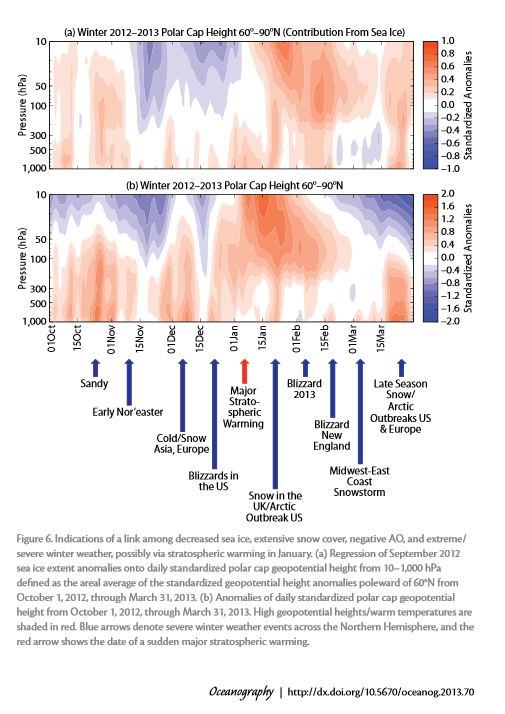
September 2012 sea ice melt achieved a new record in the satellite era, followed by a near-record rapid advance in snow cover in October. A statistical model using snow cover as its main predictor accurately forecasted below normal temperatures across northern Eurasia and the United States during winter 2013. Furthermore, the large melt of Arctic sea ice in summer/fall 2012,the rapid advance of snow cover across Eurasia in October 2012, and the predominantly negative AO phase during winter 2012/2013 may all be associated with severe winter weather across the northern continents. The PCHs show that high geopotential heights and a warm Arctic dominated the period of October 2012 to March 2013 (Figure 6),with episodic pulsing or strengthening of the positive PCH anomalies (or, equivalently, temperature anomalies).
Figures 3 and 6 show that low sea ice, extensive snow cover, and a negative winter AO share the warm Arctic/cold continents pattern and are linked with increased atmospheric blocking and extreme winter weather across the Northern Hemisphere. Dynamical models produced universally poor temperature forecasts for winter 2013. We hypothesize that the erroneous predicted model warmth across the northern continents and sea ice retreat may be related. Furthermore the maximum in temperature anomalies over the Barents Sea, which extends deep into the continental interior in the dynamical model seasonal forecasts, may offer a cautionary tale regarding a similar pattern in climate change projections. The strong coupling between seaice and atmosphere, possibly via convective feedback in the dynamical models, may disrupt the coupling between a warm Arctic and cold continents found in observations.
These lessons from seasonal prediction indicate that rapid response of sea ice to external forcing, as expressed in past abrupt climate change (Gildor and Tziperman, 2003), may lead to future surprises in the Arctic, thus increasing the uncertainties in future climate projections for the entire Northern Hemisphere.
http://www.tos.org/oceanography/archive/26-4_cohen.html
http://www.marketwatch.com/story/aer-scientists-uncover-link-between-declining-arctic-sea-ice-and-colder-winters-2013-09-12
-> conclusie uit het artikel
The winter of 2012/2013 continued a string of severe winters across the Northern Hemisphere continents. While coupled models predict that warming due to anthropogenic forcing would begreatest in the boreal winter season, over the past two to three decades, the warming trend has been muted in the winter season over some Northern Hemisphere land areas, while
warming has continued in the other three seasons (Cohen et al., 2012b). Cohen et al. (2012a) proposed that sea ice loss has contributed to moistening of the Arctic, which has resulted in more extensive snow cover in the fall that in turn forced a dynamical response in the atmosphere favorable to a negative winter AO. The enhanced snow accumulation is also consistent with the idea that low sea ice and warm temperatures lead to enhanced snow accumulation and iceage inception (Stokes, 1955; Ewing and Donn, 1956; Le Treut and Ghil, 1983; Gildor and Tziperman, 2003).
September 2012 sea ice melt achieved a new record in the satellite era, followed by a near-record rapid advance in snow cover in October. A statistical model using snow cover as its main predictor accurately forecasted below normal temperatures across northern Eurasia and the United States during winter 2013. Furthermore, the large melt of Arctic sea ice in summer/fall 2012,the rapid advance of snow cover across Eurasia in October 2012, and the predominantly negative AO phase during winter 2012/2013 may all be associated with severe winter weather across the northern continents. The PCHs show that high geopotential heights and a warm Arctic dominated the period of October 2012 to March 2013 (Figure 6),with episodic pulsing or strengthening of the positive PCH anomalies (or, equivalently, temperature anomalies).
Figures 3 and 6 show that low sea ice, extensive snow cover, and a negative winter AO share the warm Arctic/cold continents pattern and are linked with increased atmospheric blocking and extreme winter weather across the Northern Hemisphere. Dynamical models produced universally poor temperature forecasts for winter 2013. We hypothesize that the erroneous predicted model warmth across the northern continents and sea ice retreat may be related. Furthermore the maximum in temperature anomalies over the Barents Sea, which extends deep into the continental interior in the dynamical model seasonal forecasts, may offer a cautionary tale regarding a similar pattern in climate change projections. The strong coupling between seaice and atmosphere, possibly via convective feedback in the dynamical models, may disrupt the coupling between a warm Arctic and cold continents found in observations.
These lessons from seasonal prediction indicate that rapid response of sea ice to external forcing, as expressed in past abrupt climate change (Gildor and Tziperman, 2003), may lead to future surprises in the Arctic, thus increasing the uncertainties in future climate projections for the entire Northern Hemisphere.
Bericht laatst bijgewerkt: 23-09-2013 09:37
„Et nul ne se connait tant qu'il n'a pas souffert, „C'est une dure loi, mais une loi suprème, „Vieille comme le monde et la fatalité, „Qu'l nous faut du malheur regevoir le baptéme, ~Et qu'a ce triste prix tout doit étre acheté. „Les moissons pour murir out besoin de rosée, „Pour vivre et pour sentir l'homme a besoin de pleura, „La joie a pour symbole une plante brisée, „Humide encore de pluie et couverte de fleurs."
