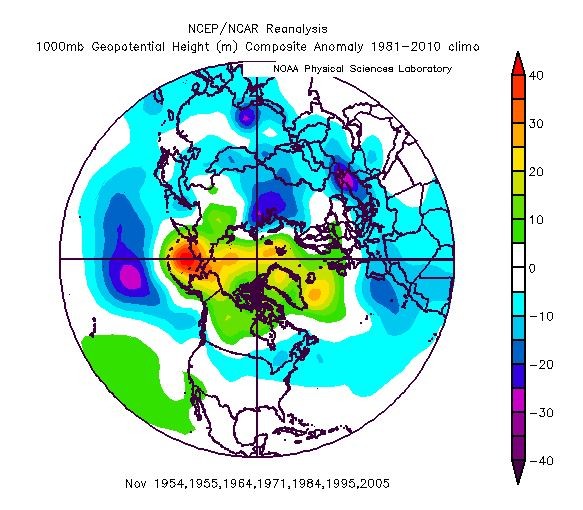
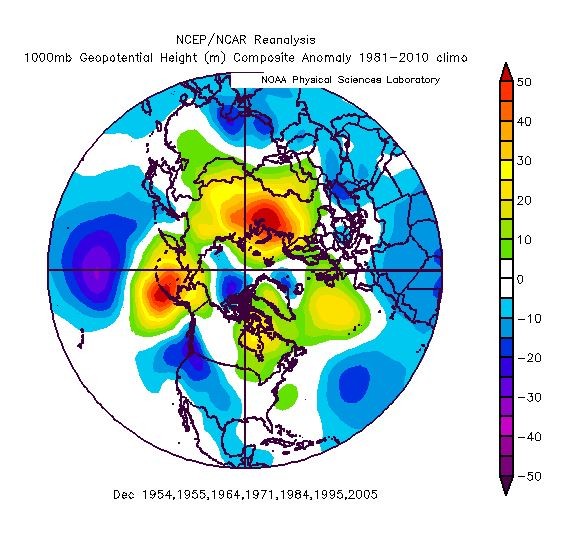
Then we identify seven EP La Niña winters (1954/55, 1955/56, 1964/65, 1971/72, 1984/85, 1995/96, and 2005/06) and seven CP La Niña winters (1973/74, 1974/75, 1975/76, 1983/84, 1988/89, 1998/99, and 2000/01). The winters, having larger SST anomaly in the EP (CP) east (west) of 150°W during the developing and mature phases of La Niña, are classified into the EP (CP) La Niña winters. The longitude of 150°W is selected because it is a boundary of Niño3 (5°S–5°N, 150°–90°W) and Niño4 (5°S–5°N, 160°E–150°W) areas, which are usually used to define the two-type ENSO events (e.g., Kim et al. 2009; Kug et al. 2009). Other three years (1970/71, 1999/00, and 2007/08) are defined as the mixed type of La Niña, because the large cooling SST anomaly covers both the EP and CP during the mature phase.
November en december. Veelbelovend, maar geen garanties.