Zuidpool:


While it is too soon to tell if sea ice around Antarctica has reached its annual maximum for the winter, it remained at record high daily levels for most of the year. On September 19, the five-day average ice extent surpassed 20 million square kilometers (7.72 million square miles) for the first time in the satellite record. Ice extent is above average in almost all sections of the Antarctic, particularly in the northern Ross Sea and Indian Ocean sectors. Near-average ice extent occurs south of South America in the northern Bellingshausen Sea and in a small region south of Australia.
Noordpool:

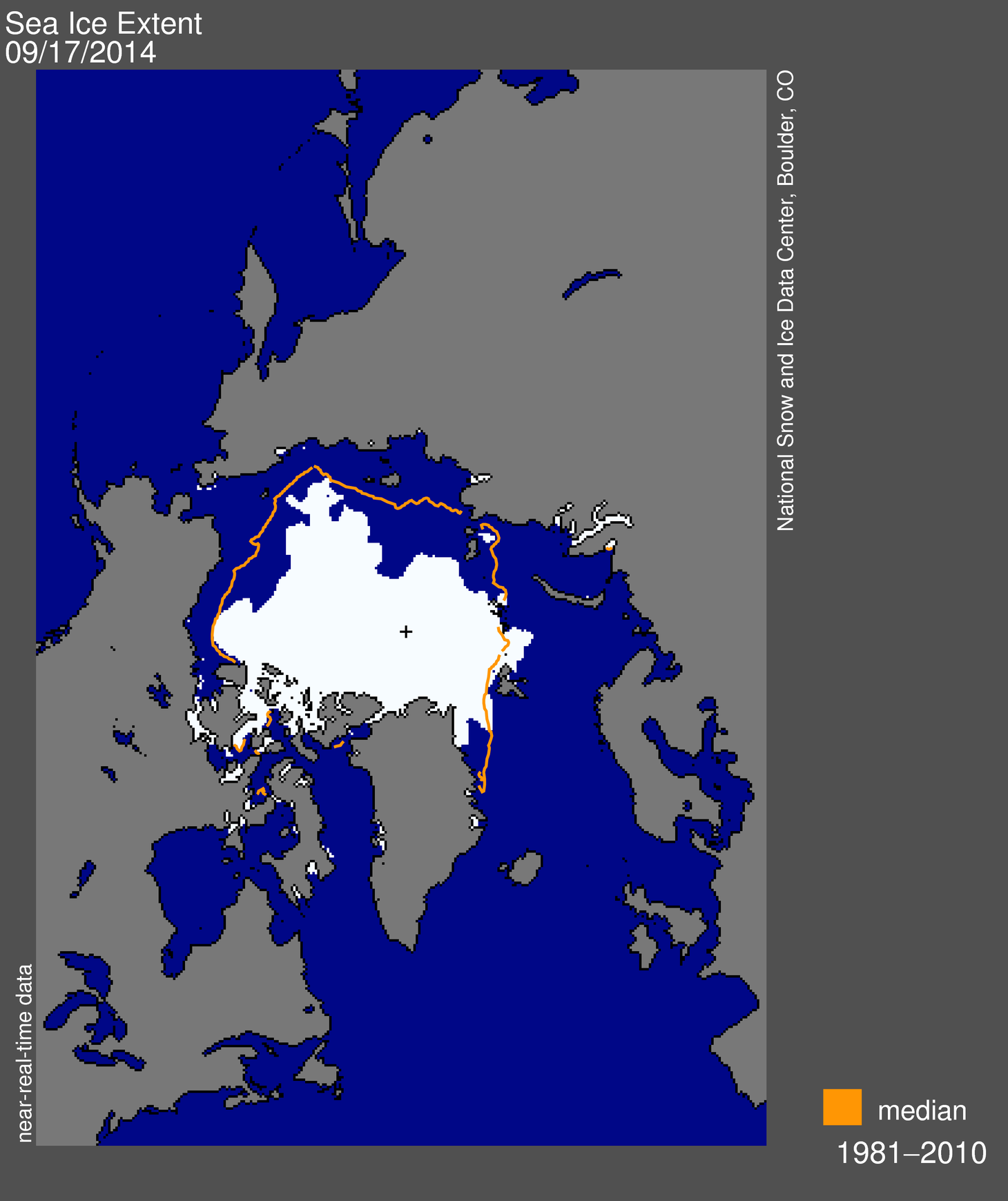
On September 17, 2014, sea ice extent dropped to 5.02 million square kilometers (1.94 million square miles). This appears to have been the lowest extent of the year. In response to the setting sun and falling temperatures, ice extent will now climb through autumn and winter. However, a shift in wind patterns or a period of late season melt could still push the ice extent lower. The minimum extent was reached two days later than the 1981 to 2010 average minimum date of September 15.
This year’s minimum was 1.61 million square kilometers (622,000 square miles) above the record minimum extent in the satellite era, which occurred on September 16, 2012, and 1.20 million square kilometers (463,000 square miles) below the 1981 to 2010 average minimum.
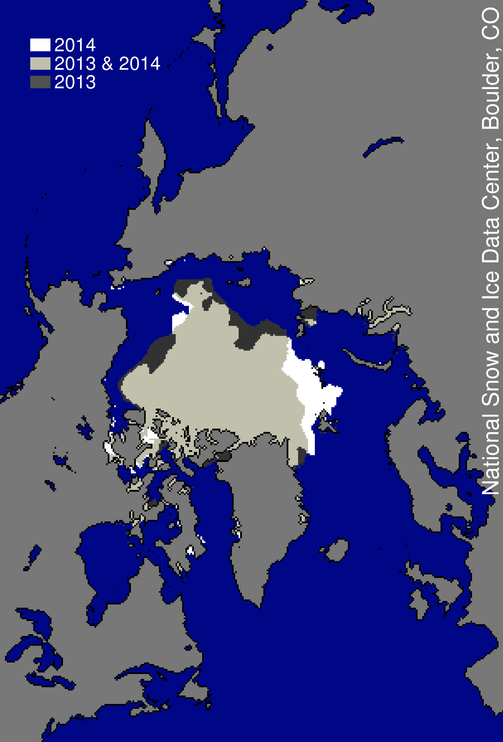
This year, the ice cover remained more extensive over the Barents and Kara seas compared to last year. The most notable feature was the lack of ice north of the Laptev Sea that at one point in the melt season extended beyond 85 degrees North latitude, within 550 kilometers (342 miles) of the North Pole. This year was also unusual compared to recent years in that the Northwest Passage remained closed. On the other side of the Arctic, the Northern Sea Route or Northeast Passage opened with little ice near most of the shipping route along the coast of Siberia.
While it is too soon to tell if sea ice around Antarctica has reached its annual maximum for the winter, it remained at record high daily levels for most of the year. On September 19, the five-day average ice extent surpassed 20 million square kilometers (7.72 million square miles) for the first time in the satellite record. Ice extent is above average in almost all sections of the Antarctic, particularly in the northern Ross Sea and Indian Ocean sectors. Near-average ice extent occurs south of South America in the northern Bellingshausen Sea and in a small region south of Australia.
Noordpool:
On September 17, 2014, sea ice extent dropped to 5.02 million square kilometers (1.94 million square miles). This appears to have been the lowest extent of the year. In response to the setting sun and falling temperatures, ice extent will now climb through autumn and winter. However, a shift in wind patterns or a period of late season melt could still push the ice extent lower. The minimum extent was reached two days later than the 1981 to 2010 average minimum date of September 15.
This year’s minimum was 1.61 million square kilometers (622,000 square miles) above the record minimum extent in the satellite era, which occurred on September 16, 2012, and 1.20 million square kilometers (463,000 square miles) below the 1981 to 2010 average minimum.
This year, the ice cover remained more extensive over the Barents and Kara seas compared to last year. The most notable feature was the lack of ice north of the Laptev Sea that at one point in the melt season extended beyond 85 degrees North latitude, within 550 kilometers (342 miles) of the North Pole. This year was also unusual compared to recent years in that the Northwest Passage remained closed. On the other side of the Arctic, the Northern Sea Route or Northeast Passage opened with little ice near most of the shipping route along the coast of Siberia.
18-jarige weeramateur, winterliefhebber en stormchaser met een KMI licentie. Vrijwilliger bij Child Focus. Motto: She didn't tell me but she showed me!