als aanvulling op de veronderstelde relatie tussen opwarming en afsmelt.
grt
Robbes
Inderdaad, interessante bronnen ook. De eerste zin in de introductie van voetnoot 7 (Recovery mechanisms of Arctic summer sea ice):
Arctic summer sea ice extent has decreased substantially in recent years, and it will very likely continue to decrease owing to anthropogenic climate change.
En:
Our results suggest that anomalous loss of Arctic sea ice during a single summer is reversible, as the ice-albedo feedback is alleviated by large-scale recovery mechanisms. Hence, hysteretic threshold behavior (or a tipping point) is unlikely to occur during the decline of Arctic summer seaice cover in the 21st century.
Zoals ik het lees concludeert die studie vooral dat afwijkingen van de langjarige trend geen blijvende veranderingen zijn. Dus een zomerstorm, zoals in 2012 bijvoorbeeld, heeft grote impact op het zeeijs-oppervlak, maar dat hersteld zich weer. Nergens in de publicatie wordt gezegd dat het totale oppervlak zich gaat herstellen naar niveaus van bijvoorbeeld tien jaar geleden, of zoals WUWT zegt:
As the Pacific Decadal Oscillation and Arctic Oscillation shift to their cool phases and solar activity wanes, natural climate cycles predict that Arctic sea ice should recover within the next 5 to 15 years. Climate models have demonstrated that Arctic sea ice can recover in just a few years after the winds change.
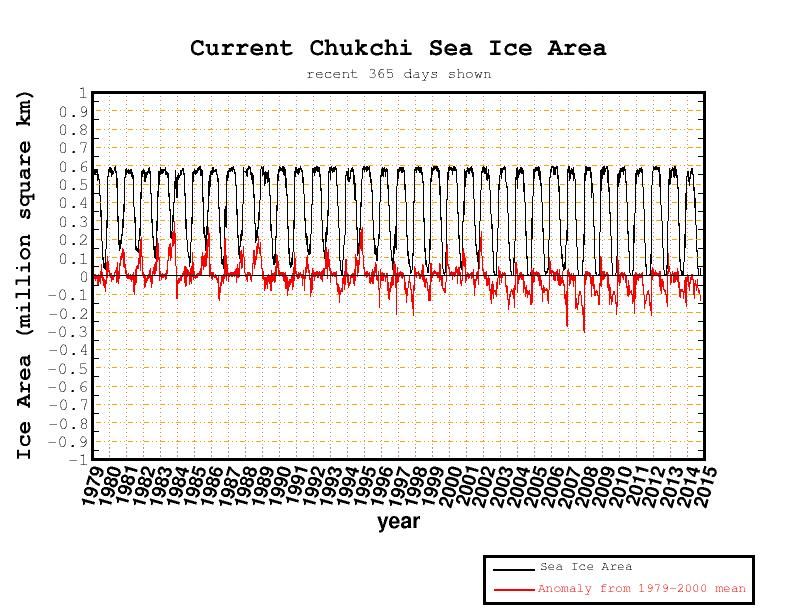
De studie over de afkoeling in Alaska laat juist zien dat aan de noord-kust (bv bij Barrow), precies waar volgens dat plaatje het zeeijs moet herstellen, er ook het decennium dat onderzocht is gewoon 1.5°C opwarming is geweest. De sterkste afkoeling bevind zich volgens die studie in het zuid-westen van Alaska. Niet het meest duidelijke plaatje, maar The Cryosphere today heeft een grafiek specifiek voor die regio:
Quote selectie