Beetje uitleg, wel handig om overzicht te houden. Bron: RealClimate.
Gr. Ben
--------------------------------
In equilibrium, the Earth must lose as much energy out the top of its atmosphere as it gains by absorption of Solar energy. This is the principle of energy balance that controls the climate of all Earthlike planets. Currently our planet is out of equilibrium because the rapid rise of carbon dioxide is more than the slow response time of the oceans can keep up with; even if CO2 increase were halted today, the planet would continue to warm for a while as it comes into equilibrium. Planets only have one way of losing energy, which is by infrared radiation to space, often called "Outgoing Longwave Radiation," or OLR. The next piece of the story is that convection is always lifting air from the ground to high altitudes in the troposphere, causing the air to cool by expansion as it rises. This is the basic reason that temperature goes down with height in the troposphere. Convection and other dynamical heat transport mechanisms link together all the air in the troposphere, so that, to a first approximation, the whole troposphere can be considered to warm and cool as a unit. It doesn't matter much where you put in or take out heat from the troposphere.. It is mainly the net energy budget of the troposphere that counts. Now, if the atmosphere contains a greenhouse gas, the atmosphere will be partly opaque to infrared trying to escape from the surface. Infrared from the surface will be absorbed before it gets very far. As a result, the infrared that escapes to space comes more from the higher, colder parts of the atmosphere. Since infrared radiation increases like the fourth power of temperature, the radiation from these layers is much feebler than the radiation that would escape from the ground. On the other hand, the radiation into the ground comes predominantly from the warm layers nearest the ground.
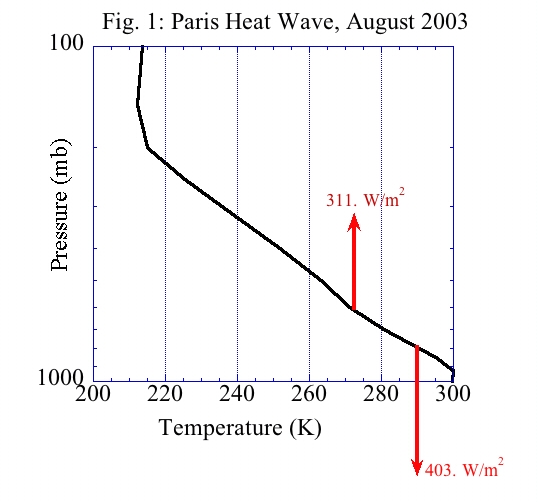
This situation is illlustrated in Figure 1, showing actual values of fluxes which I computed for a sounding over Paris during the August heat wave of 2003 (with an idealized water vapor profile having 80% relative humidity near the ground and 50% aloft). The red arrows in this figure originate at the mean altitude from which radiation escapes upward or downward. Because the radiation to space and the radiation to the ground come from different places, increasing the greenhouse gas concentration of the atmosphere would affect the two radiations in different ways.
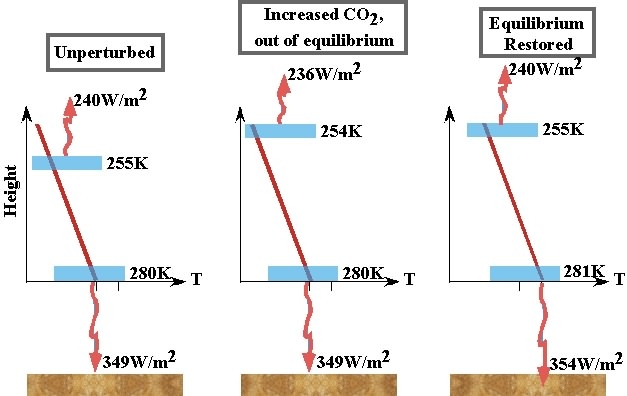
If we increase the concentration of a greenhouse gas (say, CO2), then that makes more of the atmosphere opaque to infrared, and so the infrared escapes from yet higher and thinner and colder parts of the atmosphere. This would reduce the OLR, if the temperature of the atmosphere were held fixed at its original value. The planet would then be receiving more Solar energy than it gets rid of. Solar energy is primarily absorbed at the surface and communicated to the troposphere by surface heat fluxes. This energy input stays the same, while the reduction in OLR has reduced the rate at which the atmosphere is losing energy. As a result, the troposphere must warm until the top of atmosphere energy budget is brought back into balance. Remember that the whole troposphere warms more or less as a unit. That means that the air near the ground must warm along with the rest. In this way, we see that the warming of the entire troposphere can mostly be inferred just by thinking about the top of atmosphere budget, without bringing the surface budget into the picture in any detail. So far, all we need to know about the surface budget is that all the energy absorbed at the surface eventually makes its way into the atmosphere.
We are not done yet. We still have to say how this change in the tropospheric temperature translates into a change in the temperature of the solid underlying surface on which we live. This is where the surface energy budget comes in. The complication here is that, while the top-of-atmosphere balance has only one loss term (the infrared), the surface has many ways to exchange energy with the overlying atmosphere:
* Sensible heat flux (warming or cooling air in immediated contact with the surface and then mixing it aloft by turbulent motions)
* Latent heat flux (cooling the surface by evaporation)
* Infrared heat flux (cooling by emission of infrared by the surface, and warming by absorption of downelling infrared from the atmosphere)
with latent heat flux tends to be the dominant term, because evaporation is such an effective way of transferring heat. In fact, in warm, wet places like the Tropical Pacific Ocean, the evaporative heat transfer is so effective that all the surface budget tells us is that the surface temperature must stay quite close to the overlying air temperature. In a case like this, we don't even need a detailed surface heat budget to say what the surface temperature change is -- it is just dragged along with the tropospheric temperature increase. Changes in the surface budget instead affect the amount of evaporation needed to close the budget, and hence affect the precipitation rather than the temperature. The buffering of the surface budget by evaporation limits the leverage of the surface budget on surface temperature over much of the rest of the globe, though not to the same extent as in the tropical oceans.
The preceding reasoning does not mean that changes in the surface budget cannot affect the surface temperature. The right way to view the system is that (approximately) the top of atmosphere budget determines the warming of the low level air temperature, while the surface budget determines the difference between the air temperature and the surface temperature. There are many cases where this could further modulate the primary climate change, adding to or decreasing the primary top-of-atmosphere driven warming. This is particularly the case when a formerly wet land surface dries out. For example, the hot Sahara sands are around 10 degrees C warmer than the overlying air in the daytime, because in the absence of moisture the relatively inefficient sensible and radiative heat transfers need to have a pretty large temperature difference to work with in order to get rid of the necessary amount of heat. This is also why a dry sidewalk (pavement, to UK readers) gets very hot on a hot summer day. If the Sahara were made moister (as it was some thousands of years ago) the surface would cool regardless of what CO2 is doing. Conversely, if the moister parts of North America dry out in response to CO2 increase, the reduction in soil moisture will compound the surface temperature increase. Getting back to the implications of Philipona's results, since Europe is not in a completely evaporation-dominated regime, the downwelling infrared increase could possibly allow the surface temperature to warm more rapidly than the air temperature, compounding the general global warming driven by CO2. Whether or not this happens depends in large measure on how evaporative and sensible heat fluxes adjust. This aspect of the problem was not treated by the paper. Philipona et al find that the observed downward radiation increases by roughly 2.7 Watts per square meter over and above what would be expected from the air temperature increase alone. This would lead to a surface warming of about six tenths of a degree C if it were balanced entirely by an increase in surface infrared cooling. Sensible heat flux would bring the warming down by about a factor of two. Evaporative heat flux would bring the warming down yet more, but at the expense of increasing the evaporation and aggravating the drying of soils. These climate changes are not inconsequential, especially in view of the fact that they have taken place over a relatively short period and come on top of the "normal" global warming driven by the top-of-atmosphere balance.
To see why the anthropogenic greenhouse effect does not, however, rely on the direct perturbation of the surface energy budget by greenhouse gas changes, let's consider an idealized limiting case. Suppose that the lowest dozen meters or so of the atmosphere is so full of water vapor or cloud water that it acts like a perfect black body. It is as opaque as it can be to infrared. Now suppose that we double the atmosphere's CO2 content. This doesn't increase the infrared emission to the ground, because the low level air already has so much greenhouse-substance in it that it is radiating like a perfect blackbody, whose emission is determined by its temperature alone. It is radiating as much as it possibly can, for its given temperature. In radiative transfer-speak, its emission is "saturated." Furthermore, since the low layer is opaque to infrared, the CO2-caused change in downward emission aloft does not reach the ground. Does that mean there can be no further global warming in this case? No! What happens is that the increase in CO2 throws the top-of-atmosphere budget out of kilter, forcing the whole troposphere to warm up to bring the planet back into balance. Convection links the whole troposphere, which means the low level air warms up. The warming of the low level air, in turn, increases the flux of energy into the ground by all three of the mechanisms enumerated previously. In particular, the downward infrared flux increases because the air itself has become warmer -- not because it has become more optically thick in the infrared. The increase in downward flux then communicates the warming to the surface. As Phillipona et al. show, the real midlatitude European boundary layer is not perfectly opaque to infrared, so increases in water vapor content or CO2 can directly increase the infrared heating of the surface. This is very interesting, but it is in no way essential to the anthropogenic greenhouse effect.
Gr. Ben
--------------------------------
In equilibrium, the Earth must lose as much energy out the top of its atmosphere as it gains by absorption of Solar energy. This is the principle of energy balance that controls the climate of all Earthlike planets. Currently our planet is out of equilibrium because the rapid rise of carbon dioxide is more than the slow response time of the oceans can keep up with; even if CO2 increase were halted today, the planet would continue to warm for a while as it comes into equilibrium. Planets only have one way of losing energy, which is by infrared radiation to space, often called "Outgoing Longwave Radiation," or OLR. The next piece of the story is that convection is always lifting air from the ground to high altitudes in the troposphere, causing the air to cool by expansion as it rises. This is the basic reason that temperature goes down with height in the troposphere. Convection and other dynamical heat transport mechanisms link together all the air in the troposphere, so that, to a first approximation, the whole troposphere can be considered to warm and cool as a unit. It doesn't matter much where you put in or take out heat from the troposphere.. It is mainly the net energy budget of the troposphere that counts. Now, if the atmosphere contains a greenhouse gas, the atmosphere will be partly opaque to infrared trying to escape from the surface. Infrared from the surface will be absorbed before it gets very far. As a result, the infrared that escapes to space comes more from the higher, colder parts of the atmosphere. Since infrared radiation increases like the fourth power of temperature, the radiation from these layers is much feebler than the radiation that would escape from the ground. On the other hand, the radiation into the ground comes predominantly from the warm layers nearest the ground.
This situation is illlustrated in Figure 1, showing actual values of fluxes which I computed for a sounding over Paris during the August heat wave of 2003 (with an idealized water vapor profile having 80% relative humidity near the ground and 50% aloft). The red arrows in this figure originate at the mean altitude from which radiation escapes upward or downward. Because the radiation to space and the radiation to the ground come from different places, increasing the greenhouse gas concentration of the atmosphere would affect the two radiations in different ways.
If we increase the concentration of a greenhouse gas (say, CO2), then that makes more of the atmosphere opaque to infrared, and so the infrared escapes from yet higher and thinner and colder parts of the atmosphere. This would reduce the OLR, if the temperature of the atmosphere were held fixed at its original value. The planet would then be receiving more Solar energy than it gets rid of. Solar energy is primarily absorbed at the surface and communicated to the troposphere by surface heat fluxes. This energy input stays the same, while the reduction in OLR has reduced the rate at which the atmosphere is losing energy. As a result, the troposphere must warm until the top of atmosphere energy budget is brought back into balance. Remember that the whole troposphere warms more or less as a unit. That means that the air near the ground must warm along with the rest. In this way, we see that the warming of the entire troposphere can mostly be inferred just by thinking about the top of atmosphere budget, without bringing the surface budget into the picture in any detail. So far, all we need to know about the surface budget is that all the energy absorbed at the surface eventually makes its way into the atmosphere.
We are not done yet. We still have to say how this change in the tropospheric temperature translates into a change in the temperature of the solid underlying surface on which we live. This is where the surface energy budget comes in. The complication here is that, while the top-of-atmosphere balance has only one loss term (the infrared), the surface has many ways to exchange energy with the overlying atmosphere:
* Sensible heat flux (warming or cooling air in immediated contact with the surface and then mixing it aloft by turbulent motions)
* Latent heat flux (cooling the surface by evaporation)
* Infrared heat flux (cooling by emission of infrared by the surface, and warming by absorption of downelling infrared from the atmosphere)
with latent heat flux tends to be the dominant term, because evaporation is such an effective way of transferring heat. In fact, in warm, wet places like the Tropical Pacific Ocean, the evaporative heat transfer is so effective that all the surface budget tells us is that the surface temperature must stay quite close to the overlying air temperature. In a case like this, we don't even need a detailed surface heat budget to say what the surface temperature change is -- it is just dragged along with the tropospheric temperature increase. Changes in the surface budget instead affect the amount of evaporation needed to close the budget, and hence affect the precipitation rather than the temperature. The buffering of the surface budget by evaporation limits the leverage of the surface budget on surface temperature over much of the rest of the globe, though not to the same extent as in the tropical oceans.
The preceding reasoning does not mean that changes in the surface budget cannot affect the surface temperature. The right way to view the system is that (approximately) the top of atmosphere budget determines the warming of the low level air temperature, while the surface budget determines the difference between the air temperature and the surface temperature. There are many cases where this could further modulate the primary climate change, adding to or decreasing the primary top-of-atmosphere driven warming. This is particularly the case when a formerly wet land surface dries out. For example, the hot Sahara sands are around 10 degrees C warmer than the overlying air in the daytime, because in the absence of moisture the relatively inefficient sensible and radiative heat transfers need to have a pretty large temperature difference to work with in order to get rid of the necessary amount of heat. This is also why a dry sidewalk (pavement, to UK readers) gets very hot on a hot summer day. If the Sahara were made moister (as it was some thousands of years ago) the surface would cool regardless of what CO2 is doing. Conversely, if the moister parts of North America dry out in response to CO2 increase, the reduction in soil moisture will compound the surface temperature increase. Getting back to the implications of Philipona's results, since Europe is not in a completely evaporation-dominated regime, the downwelling infrared increase could possibly allow the surface temperature to warm more rapidly than the air temperature, compounding the general global warming driven by CO2. Whether or not this happens depends in large measure on how evaporative and sensible heat fluxes adjust. This aspect of the problem was not treated by the paper. Philipona et al find that the observed downward radiation increases by roughly 2.7 Watts per square meter over and above what would be expected from the air temperature increase alone. This would lead to a surface warming of about six tenths of a degree C if it were balanced entirely by an increase in surface infrared cooling. Sensible heat flux would bring the warming down by about a factor of two. Evaporative heat flux would bring the warming down yet more, but at the expense of increasing the evaporation and aggravating the drying of soils. These climate changes are not inconsequential, especially in view of the fact that they have taken place over a relatively short period and come on top of the "normal" global warming driven by the top-of-atmosphere balance.
To see why the anthropogenic greenhouse effect does not, however, rely on the direct perturbation of the surface energy budget by greenhouse gas changes, let's consider an idealized limiting case. Suppose that the lowest dozen meters or so of the atmosphere is so full of water vapor or cloud water that it acts like a perfect black body. It is as opaque as it can be to infrared. Now suppose that we double the atmosphere's CO2 content. This doesn't increase the infrared emission to the ground, because the low level air already has so much greenhouse-substance in it that it is radiating like a perfect blackbody, whose emission is determined by its temperature alone. It is radiating as much as it possibly can, for its given temperature. In radiative transfer-speak, its emission is "saturated." Furthermore, since the low layer is opaque to infrared, the CO2-caused change in downward emission aloft does not reach the ground. Does that mean there can be no further global warming in this case? No! What happens is that the increase in CO2 throws the top-of-atmosphere budget out of kilter, forcing the whole troposphere to warm up to bring the planet back into balance. Convection links the whole troposphere, which means the low level air warms up. The warming of the low level air, in turn, increases the flux of energy into the ground by all three of the mechanisms enumerated previously. In particular, the downward infrared flux increases because the air itself has become warmer -- not because it has become more optically thick in the infrared. The increase in downward flux then communicates the warming to the surface. As Phillipona et al. show, the real midlatitude European boundary layer is not perfectly opaque to infrared, so increases in water vapor content or CO2 can directly increase the infrared heating of the surface. This is very interesting, but it is in no way essential to the anthropogenic greenhouse effect.