Herkomst is talrijke bronnen: boomringen, alle soorten sedimenten, ijsboringen, etc. Iemand verwees er al naar, hoofdstuk zes van het nieuwe IPCC rapport: Paleoclimate. Hierin wordt helemaal behandeld hoe de reconstructies van de temperatuur over 1000-2000 o.a. tot stand zijn gekomen en hoe betrouwbaar / reproduceerbaar die zijn. Wegens tijdgebrek sluit ik even af met een citaat uit de technical summary hierover:
,,Palaeoclimatic studies make use of measurements of
past change derived from borehole temperatures, ocean
sediment pore-water change and glacier extent changes,
as well as proxy measurements involving the changes in
chemical, physical and biological parameters that reflect
past changes in the environment where the proxy grew or
existed. Palaeoclimatic studies rely on multiple proxies so
that results can be cross-verified and uncertainties better
understood. It is now well accepted and verified that
many biological organisms (e.g., trees, corals, plankton,
animals) alter their growth and/or population dynamics
in response to changing climate, and that these climateinduced
changes are well recorded in past growth in
living and dead (fossil) specimens or assemblages of
organisms. Networks of tree ring width and tree ring
density chronologies are used to infer past temperature
changes based on calibration with temporally overlapping
instrumental data. While these methods are heavily used,
there are concerns regarding the distributions of available
measurements, how well these sample the globe, and such
issues as the degree to which the methods have spatial and
seasonal biases or apparent divergence in the relationship
with recent climate change. {6.2}
(..)
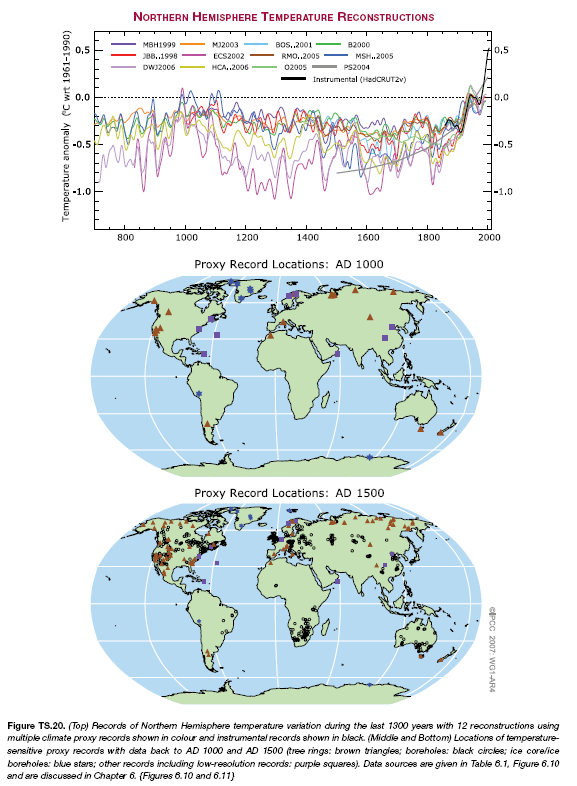
It is very likely that average NH temperatures
during the second half of the 20th century were
warmer than any other 50-year period in the last
500 years and likely the warmest in at least the past
1300 years. The data supporting these conclusions
are most extensive over summer extratropical land
areas (particularly for the longer time period; see
Figure TS.20).''
Figuur TS.20 is hieronder afgebeeld. Noot: likely is >66% kans, very likely is >90% kans.
Gr. Ben Quote selectie
,,Palaeoclimatic studies make use of measurements of
past change derived from borehole temperatures, ocean
sediment pore-water change and glacier extent changes,
as well as proxy measurements involving the changes in
chemical, physical and biological parameters that reflect
past changes in the environment where the proxy grew or
existed. Palaeoclimatic studies rely on multiple proxies so
that results can be cross-verified and uncertainties better
understood. It is now well accepted and verified that
many biological organisms (e.g., trees, corals, plankton,
animals) alter their growth and/or population dynamics
in response to changing climate, and that these climateinduced
changes are well recorded in past growth in
living and dead (fossil) specimens or assemblages of
organisms. Networks of tree ring width and tree ring
density chronologies are used to infer past temperature
changes based on calibration with temporally overlapping
instrumental data. While these methods are heavily used,
there are concerns regarding the distributions of available
measurements, how well these sample the globe, and such
issues as the degree to which the methods have spatial and
seasonal biases or apparent divergence in the relationship
with recent climate change. {6.2}
(..)
It is very likely that average NH temperatures
during the second half of the 20th century were
warmer than any other 50-year period in the last
500 years and likely the warmest in at least the past
1300 years. The data supporting these conclusions
are most extensive over summer extratropical land
areas (particularly for the longer time period; see
Figure TS.20).''
Figuur TS.20 is hieronder afgebeeld. Noot: likely is >66% kans, very likely is >90% kans.
Gr. Ben Quote selectie
Bericht laatst bijgewerkt: 09-05-2007 22:59
